Articles Archive

Aug 16 2010

Inside a Charging Bull


Iceland, one year on
By Haukur Már Helgason

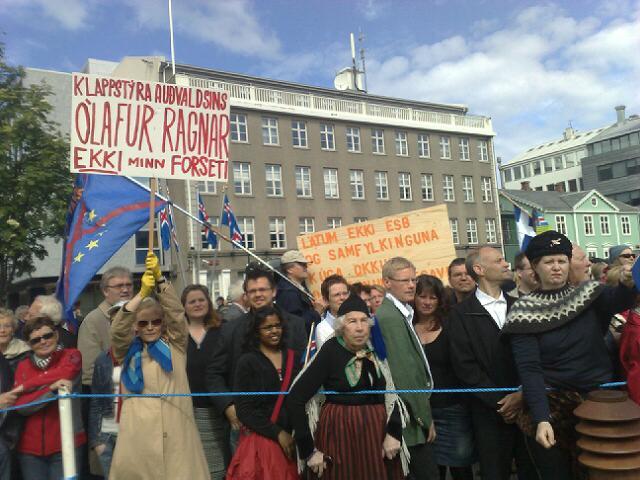
After Iceland’s three banks collapsed in October 2008 – a bankruptcy bigger than Lehmann Brothers’ in a republic of 300,000 inhabitants – the public overthrew a neoliberal government through mass protest, precipitating a general election. On election day, 25 April 2009, the conservative head of Iceland’s public radio newsroom sighed his relief: ‘Judging from the atmosphere this winter a revolution was foreseeable in spring, some sort of revolution – that something entirely different from what we are used to would take over. Now we know better.’(1) Read More

Aug 12 2010
1 Comment

The Energy Export and the Privatisation of HS Orka


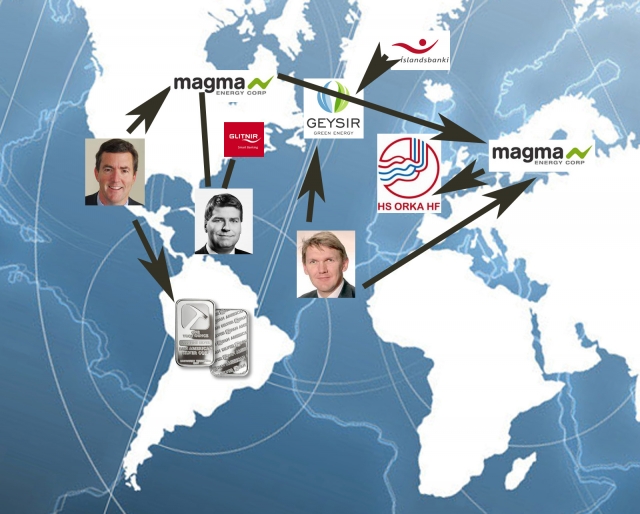
It has hardly escaped the attention of anyone living in Iceland of late, that the Canadian geothermal company, Magma Energy, recently bought Geysir Green Energy´s (another geothermal energy company) stock in HS Orka (southwest-peninsula power company), making Magma a majority stockholder with 98,5% partnership. Magma´s purchase of GGE´s stock comes as no surprise whereas it´s been clear from the onset that Magma intended to claim majority ownership over HS Orka.

Small and Cute – For Concerned Icelanders

Ross Beaty, CEO of Magma Energy, has repeatedly been asked if he´s exploiting Iceland´s economic turmoil to claim control over the country´s resources, which he has always denied. On the 26th of August last year when he appeared on Kastljós, an ‘after-news special’ program on RUV (Icelandic National Broadcasting Association), Beaty also denied being interested in more power plants. “No, we´re focusing on this now. This is a small nation and it doesn´t serve our purposes to become to big”.

Because of exactly these comments, the announcement that HS Orka had sought permission to do test drilling in Hrunamannaafrétti, from Flúðir and into Kerlingarfjöll in search of geothermal areas garnered a considerate ammount of attention. Keep in mind that a research permission is not a permission to raise a power plant, but still, just drilling one test hole can cause a considerate ammount of damage on pristine land. Then, just a few days later, RUV news reported that Suðurorka, an energy company owned by HS Orka and The Icelandic Power Company (a consulting company), has plans of building a dam in Skaftárhreppur, the 150 MW Búlandsdam, over the next four years. HS Orka seems therefore to be on the warpath.

Read More
Jul 16 2010
4 Comments

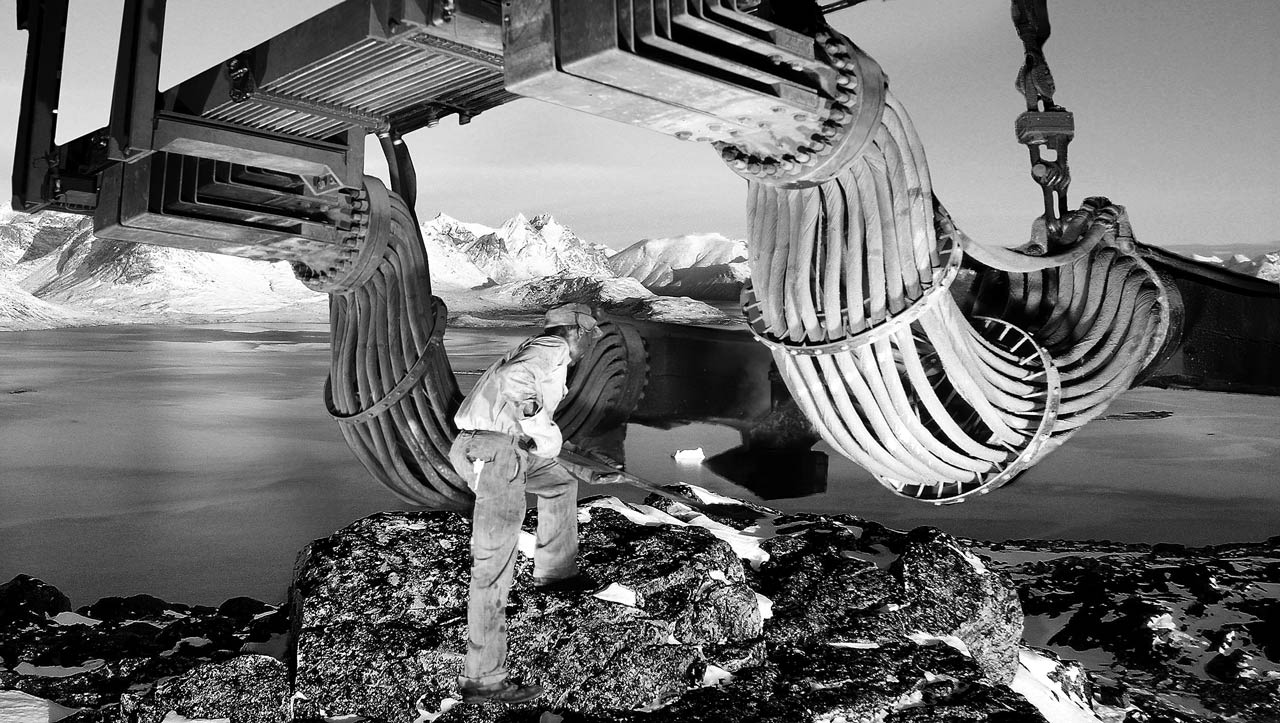
Greenland’s Decision: Nature or Culture?


Miriam Rose

Climate change has made Greenland the next industrial frontier, but at what cost?


Humanity is in denial. We know that our hyperactive extraction of fuels, metals and minerals, and their dirty processing, consuming and dumping for our consumer ‘growth’ society is killing the planet and ourselves. We also know that all of these sugary treats are finite. But like an insolent toddler we continue; more and more, faster and faster – running in denial from the planetary spanking that is undoubtedly coming our way.

I have often hoped that the global emergency of climate change, combined with the inescapable reality of peak oil would wake us up from this selfish resource-gorging, and perhaps it still will before it is too late (too late: I.e tomorrow? 2012? 2020? a few months ago?). But in the meantime,  nature has given western capitalism one last laugh. As the ice drips and cracks from Greenland’s white mass it is exposing a treasure trove of minerals, metals, ores and oil (one of the highest concentrations in the world), and plentiful hydro-power to help us heat, break and alter them into things we ‘need’. Just as the candle wick flares and gutters on our oil-driven consumptive society Greenland’s bounty has given it one more chance. One last bright flame, to hide from us the surrounding darkness.

Read More

Jul 15 2010

The Suffering of the Humble.. and Our Complicity


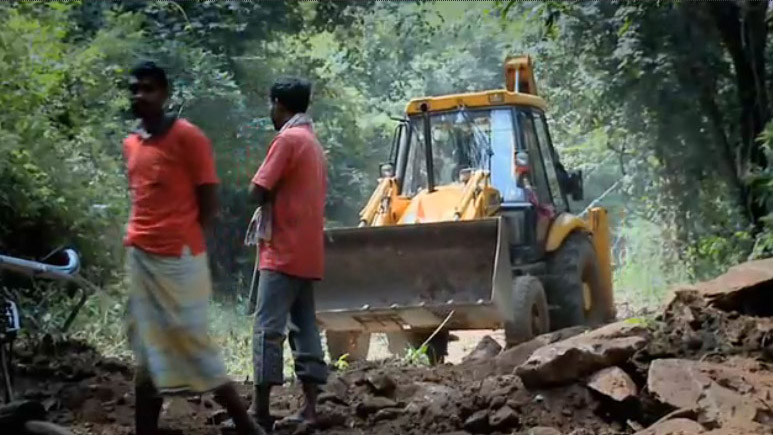
Orissa invaded by VedantaOrissa is the most mineral rich state in India. It is green and fertile, a patchwork of tiny fields and thickly forested mountains with waterfalls tumbling over their red rocks. Like many of the world’s remaining areas of natural fertility, these mountains are largely populated by tribal peoples, which in India are called Adivasis – meaning literally ‘the original inhabitants’ – and are thought to be one of the oldest civilisations in the world. One quarter of the Orissan population are tribal, making it also the ‘poorest’ state in India according to the World Bank. But its figures judge well-being only by monetary exchange, and fail to mention that there has never been a famine recorded here, and that many Adivasis rarely use money, living in balance with the mountains, streams and forests which provide everything they need. In thanks for natures’ providence many Adivasi cultures worship the mountains on which they depend as Gods, and vow to protect their bountiful natural systems from damage. Some of the Orissan mountains are among the last ancient forest capped hills in India, thanks to the determination of tribal inhabitants against British colonial efforts to log them.
Read More

Jul 13 2010
4 Comments

Saving Iceland Mobilisation Call-Out


Join our resistance against the industrialization of Europe’s last remaining great wilderness and take direct action against heavy industry!

The Struggle So Far
The campaign to defend Europe’s greatest remaining wilderness continues. For the past five years summer direct action camps in Iceland have targeted aluminium smelters, mega-dams and geothermal power plants.

After the terrible destruction as a result of building Europe’s largest dam at Kárahnjúkar and massive geothermal plants at Hengill, there is still time to crush the ‘master plan’ that would have each major glacial river dammed, every substantial geothermal field exploited and the construction of aluminium smelters, an oil refinery, data farms and silicon factories. This would not only destroy unique landscapes and ecosystems but also lead to a massive increase in Iceland’s greenhouse gas emissions. Read More

Jun 30 2010
1 Comment

Iceland’s Post-Collapse Trial


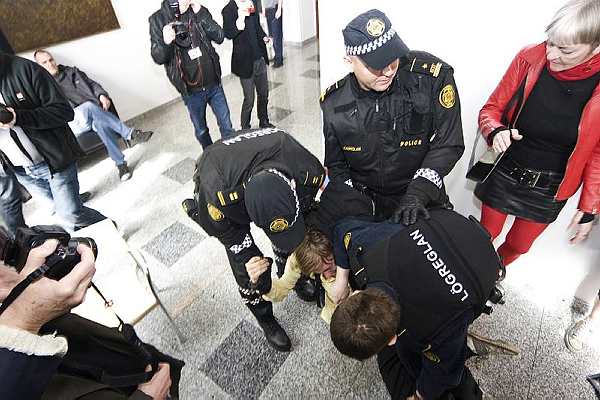
Iceland’s first post-collapse trial continued yesterday. Nine participants of the ‘Cutlery Uprising’ face charges of ‘endangering the autonomy of parliament.’

In relation to the events surrounding Iceland’s economic collapse of 2008, nine Icelandic citizens stood in court yesterday. Each face up to sixteen years imprisonment. Yet they weren’t the politicians, bankers and businessmen who landed the country with a crippling €50 billion debt. Quite the opposite, actually.

The Reykjavik Nine (RVK9) are a gaggle of Icelanders who legally entered their Parliament to demand their politicians resign; one month and half before their government stood down. They each face charges of endangering parliament’s ‘autonomy’.

In April this year a parliamentary report was published which singled out the ‘gross negligence’ of seven high-power individuals responsible for crippling the islands economy. Said Johanna Sigurdardottir, the countries new prime minister, ‘The private banks failed, the supervisory system failed, the politics failed, the administration failed, the media failed, and the ideology of an unregulated free market utterly failed.’

Ironically, the counter-establishment protesters are the ones who have been charged. Read More

Jun 09 2010
1 Comment

The Impact of Heavy Industry Whitewashed – The Report of the Special Investigation Commission


Wilderness under attackThis article originally appeared in the June issue of the independent newsmagasine Róstur.
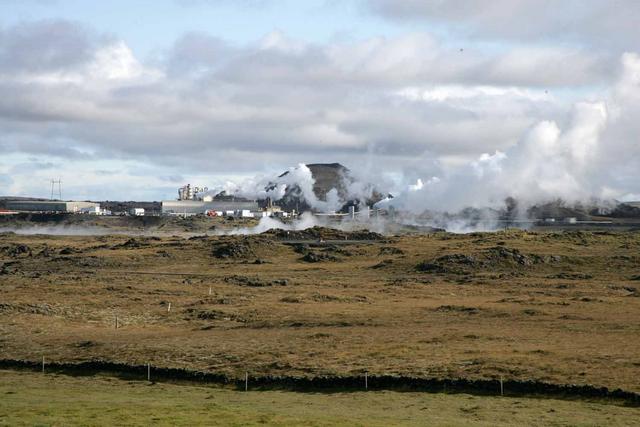
The Whitewash report, or “Investigative report of the Special Investigation Commission”  made by the Special Investigation Comission (SIC) on orders from Alþingi (The Icelandic Parliament) under the pretence of investigating “the prelude to and cause of the crash of the Icelandic banks and related events”, which also is the subtitle of the report, has been disected by the media and heavily discussed on public forums for the last couple of months. The major medias and other groups of interest have been busy covering it chapter by chapter, drawing out the main conclusions of each part into few sentances to make it easily accessable to their readers. But not all of the chapters are getting equal coverage. Most of the focus has been on selected chapters relating to indictable actions and negligence on behalf of government and bank officials in the run-up to the collapse, the processes of the privatisation policy, especially towards the banks, and the loan books and other financial documentation revealed by the report. In that way, the major medias and other public opinionmakers are, like always, backing up the authorities in their defence of the current political system. All coverage about the report is directed towards these few selected parts, scapegoating a few people from the pre-crash financial sector along with expendable and retired politicians to spare the rest. This has resulted in a black-out of all discussion about the most important and revealing parts of the report, namely the parts about the economic impact of the industrialisation policy. Read More

May 22 2010
1 Comment

Magma Energy Lied to Us


This article, written by Catharine Fulton was originally published on grapevine.is

Geothermal PlantLet’s cut to the chase. The opacity of Icelandic business and politics has done the country, as a whole, no favours. Much hand shaking and back scratching has gone on behind closed doors and such secluded business environments have proved themselves to be breeding grounds for lies, corruption, fraud, swindling, and downright thievery.

With Icelandic bankers being held in local prisons and wanted by Interpol and the once celebrated “outvasion Vikings” having their pants sued off by the Americans, now is a time to usher in a new, honest era of business in Iceland in an effort to get the country and its economy back on track and to restore the trust of the mass populace in the system.

Read More

Jan 28 2010

Greenwashing Hydropower


by Aviva Imhof & Guy R. Lanza

DamBig dams have a serious record of social and environmental destruction, and there are many alternatives. So why are they still being built?

On a hot May day, a peasant farmer named Bounsouk looks out across the vast expanse of water before him, the 450-square-kilometer reservoir behind the new Nam Theun 2 dam in Laos. At the bottom of the reservoir is the land where he once lived, grew rice, grazed buffalo, and collected forest fruits, berries, and medicinal plants and spices. Now there is just water, water everywhere.

Read More

Jan 15 2010

Green is the New Spectacle


By Jason Slade
Originally published in the Nor easter

The Spectacle

Environmental issues can oftentimes be very complex. Some issues directly relate to climate change, and some do not. However, it is very important to connect the dots between issues because almost all environmental problems are caused, at their base, by capitalist expansion, commodification and privatization. Corporations have used the climate crisis and growing public concern about environmental issues to their advantage. They have learned to use the rhetoric of environmentalism to justify extremely oppressive projects whose sole purpose is to increase their power and to continue the cycle of production and consumption. Incredibly destructive projects, such as hydrofracture natural gas extraction in Upstate New York, are marketed as clean. This absurd spectacle must be stopped.

In Guy Debord’s Society of the Spectacle, he writes, “The spectacle presents itself simultaneously as all of society, as part of society, and as instrument of unification … The spectacle grasped in its totality is both the result and the project of the existing mode of production. It is not a supplement to the real world, an additional decoration. It is the heart of the unrealism of the real society. In all its specific forms, as information or propaganda, as advertisement or direct entertainment consumption, the spectacle is the present model of socially dominant life … It is the sun which never sets over the empire of modern passivity. It covers the entire surface of the world and bathes endlessly in its own glory.” And now the light of that sun is green. The green spectacle is confronting the climate crisis with hollow solutions presented to us in a pleasant, prefabricated package that can be bought if we can afford them and allow us to pollute in good conscience. In an absurd twist, these corporate false solutions cause the poor, and those who resist these schemes, to be blamed for destroying the planet. “It is not the oil companies who are to blame for climate change, but the poor who do not buy carbon offsets when they travel.” Thus, the climate crisis becomes another way to make money and increase corporate power. Read More