Articles Archive
Jan 31 2011
4 Comments
Alterra Power/Magma Energy, Century Aluminum, Ecology, Economic Collapse, Geothermal Energy, H.S. Orka, Helguvík, Hengill, Krýsuvík, Landsvirkjun, norðurál, Reykjanes, Reykjavik Energy, Sigmundur Einarsson, Þjórsá
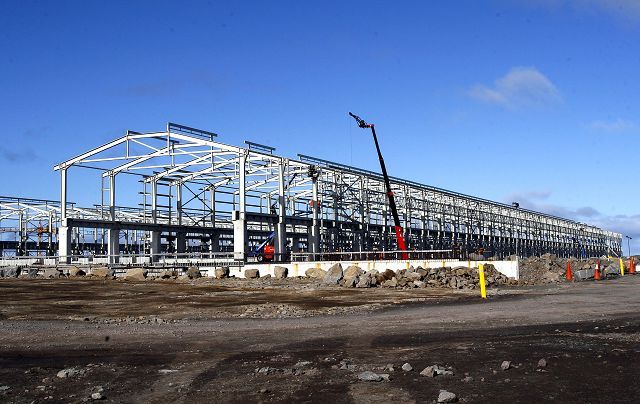
Century Aluminum (Nordural) intends to build an aluminium smelter at Helguvík for producing 250.000 tpy, using 435 MW of electricity. At one point the intended size grew to 600.000 tpy and 625 MW of electricity but those plans have been cancelled. The first phase of the smelter was expected to start in 2010 and the 250.000 ton should be reached in 2013. Now there are already some big structures at the smelter site but no energy has been produced and moreover, there is no energy available.
Sigmundur Einarsson, a geologist at the Icelandic Institute of Natural History, has written some articles on this matter (in Icelandic). He has tried, amongst a number of other environmental scientists, to warn the Icelandic government about a new kind of collapse, an energy collapse due to following far too optimistic speculation of irresponsible people. Read More
Jan 29 2011
1 Comment
ALCOA, Bauxite, Greenland, India, Mining, Miriam Rose, Orissa, Rio Tinto Alcan, Samarendra Das, Saving Iceland, Trinidad & Tobago, Vedanta
These news about Dongria Kondh’s victory against Vedanta are not recent, but from August 2010. Unfortunately we were not able to publish the story until now.
Miriam Rose
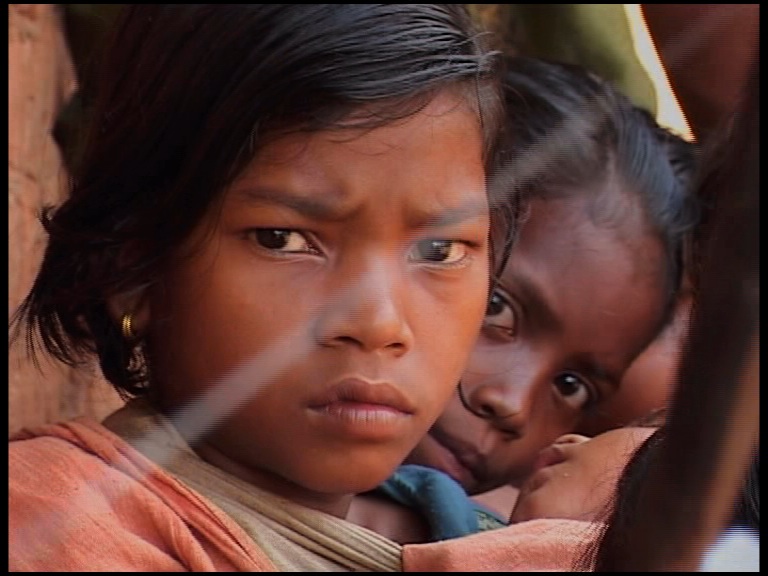
After 13 years of continuous battle, the people’s movements to save the Niyamgiri hills from bauxite mining have won their land and livelihood back from the jaws of extinction. Niyamgiri is one of a series of threatened bauxite capped mountains in Orissa. On August 21st 2010 a review of the Vedanta mining project carried out by the Ministry of the Environment exposed the company’s “total contempt for the law”, having violated a number of environmental regulations, and revealed “an appalling degree of collusion” by local government officials with Vedanta. A few days later Environment Minister Jairam Ramesh called a halt to the project. Read More
Jan 28 2011
2 Comments
Corruption, Democracy deficit, Economic Collapse, Economics, Saving Iceland, SIC Report
Magnús Sveinn Helgason
The Reykjavík Grapevine
January 2011
While history—meaning: ‘the past’—does not change, history—meaning: ‘the narration of past events’—does in fact change. This is because we view history through the lens of the present. As events unfold, the meaning and significance of the past changes. And because our view of the past changes we constantly need to change our history textbooks.
So, it is pretty hard to predict how any event, let alone a whole decade, will be remembered. Because we do not know what the future holds, or what academic fads will reign among future historians, it is exceedingly difficult to say with any certainty how future historians will judge this first decade of the 21st century. Still, even if we lack the necessary hindsight of history, we can make some pretty good educated guesses. Read More
Jan 26 2011
Democracy deficit, Repression, RVK9
The Guardian
Jórunn Edda Helgadóttir and Guðjón Idir
Nine protesters on trial for entering the Iceland parliament may be jailed despite a lack of evidence against them
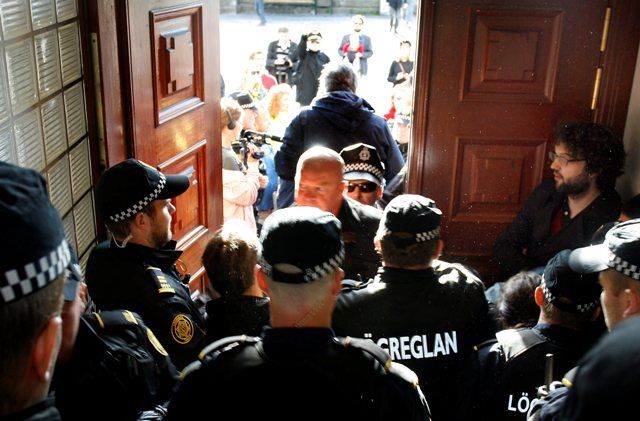
Nine people went on trial in Iceland last week, charged with threatening the country’s parliament – a charge that has only been used once before and that carries a maximum life sentence. They were among 30 demonstrators who entered the parliament building via the visitors’ door during a small protest in December 2008 at a time when thousands of Icelanders took to the streets to express their outrage at the government’s part in the financial crisis. Read More
Dec 21 2010
ALCOA, Pollution
Lori Pottinger
Huffington Post
21 December 2010
Please, ma’am, just put down the aluminum foil and no one gets hurt.
It’s a little known fact that this simple kitchen product has a Dickensian dark side. So as you serve your guests canned beverages, “tent” your turkey, cover the yams, or wrap leftovers at the end of the party, keep in mind that the aluminum products you’re using have their roots in a dirty industry — one that frankly deserves a lump of coal in its stocking for how it’s mistreating the planet.
The aluminum industry is the world’s largest industrial consumer of electricity, and about half of what it uses comes from hydropower dams. Aluminum companies troll the world looking for big dam projects that can power new smelters, often targeting rivers in ecologically sensitive areas in developing countries, and frequently in places where basic needs for the population’s energy are not being met. Read More
Dec 20 2010
2 Comments
ALCOA, Alterra Power/Magma Energy, Andri Snaer Magnason, Century Aluminum, Economics, H.S. Orka, Pollution, Saving Iceland
In the land of trolls, hidden fairies and enchanted volcanoes, a modern, more sinister power is looming: aluminum smelting and electricity companies Ella Rubeli reports
Iceland is a country in constant change. A volcanic kingdom, since the dawn of time a war has waged between fire and ice. The remote island nation lies across a fissure between the continental plates of America and Europe, which are in constant rift, tearing tissues of earth apart and sporadically releasing surges of lava and gushing geysers. Since man learnt to harness this earthly power, the culture of Iceland has changed dramatically.
Suspended from the ceiling of the world, Iceland is a leading light in renewable energy production. A land of magnificent glacier-carved fjords and heat that blisters up through the earth’s core, it produces energy far beyond its domestic needs – all from hydroelectric power and geothermal plants. But this clean, cheap energy brings in polluting industry and international corporations. Read More
Oct 14 2010
Geothermal Energy, Greenwash
The following article by Nanna Árnadóttir originally appeared on Iceland Review‘s website on the 9th of Október 2010.
About week ago I was faffing about on a whale watching boat—ironically docked across from a whaling boat—for the premier of a short environmental film made by Icelandic legend Ómar Ragnarsson.
For those of you who don’t know who Ómar Ragnarsson is, he’s sort of been everything you can think of: writer, journalist, comedian, TV personality, politician and most importantly now, Iceland’s most prominent environmentalist.
This man is Icelandic nature’s greatest warrior. He has protested, spoken openly about the damage aluminum smelters have done to our countryside and is the most vocal person in Iceland right now about the future of geothermal energy.
I managed to have a conversation with him about it (a shining moment in my life, actually) and he blew my mind. Read More
Oct 12 2010
3 Comments
Bauxite, Environmental Catastrophe, Hungary, India, Jamaica, MAL Zrt, Pollution, Red Mud, Samarendra Das
The residents described « a mini-tsunami ». A toxic one.
Last Monday, the red mud reservoir of an alumina plant ruptured in Hungary, near Ajka, 165km west of Budapest. As a result, 1.1 million cubic meters of red mud wiped out several villages through waves more than 2 meters high. It flooded 40 square kilometers of land, including affluents of the Danube, then reached one of Europe’s longest river on Thursday morning. So far, 7 people have been killed, 1 is still missing, and more than 150 have been injured, mostly by chemical burns. The death toll is still expected to rise.
As we write these lines, surrounding villages are being evacuated as the structure threatens to break in another point, which would result in another 500 000 cubic meters flooding the area.
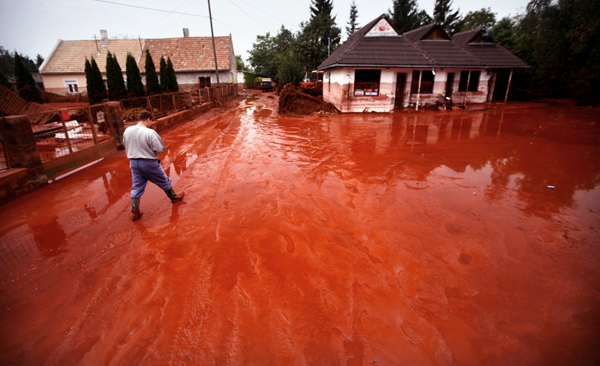 The disastrous chemical accident has been declared Hungary’s largest and most dangerous environmental catastrophe, exceeding by far the 130000 cubic meters of cyanide-tainted water that spilled in 2000 in Baia Mare, Romania. Ten years later, traces of cyanide are still found in the area. It is worth noting that this cyanide was in a liquid form, therefore very quickly carried aways by the river whereas the thick red mud will sit there for years, sipping into the ground and reaching ground waters.
Read More
Aug 23 2010
6 Comments
Bauxite, India, Mining, Samarendra Das
 By Samarendra Das & Felix Padel
(Article for ‘The Global Economic History of Bauxite’, Canada 2010)
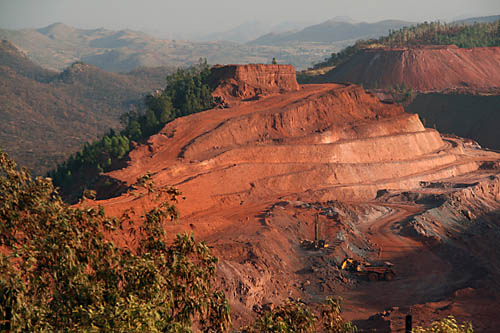
Most critiques of the aluminium industry focus on refineries and smelters, which are among the worst culprits of global heating. But bauxite mining excavates a huge surface area, and has caused environmental devastation in Jamaica, Guinea, Australia, India and recently also in Vietnam.
Perhaps no bauxite deposits are located in more sensitive areas than those in India, whose most significant deposits occur as cappings on the biggest mountains in south Orissa and north Andhra Pradesh. Tribal people live in hundreds of communities around these mountains, which they regard as sacred entities for the fertility they promote. Appropriately, the base rock of these mountains was named ‘Khondalite’ after the region’s predominant tribe, the Konds. Early geologists noticed the perennial streams flowing from these mountains, and modern evidence suggests that their water regime is severely damaged when the bauxite cappings are mined.
Bauxite has probably never been sold for a price commensurate with the damage done by mining it. For Konds and other small-scale farmers in East India, the aluminium industry brings a drastic disturbance to their way of life and standard of living that amounts to cultural genocide. If mainstream society sees these bauxite cappings of India’s Eastern Ghats as resources standing ‘unutilised’, Adivasi culture understands them as sources of life, and sees mining them as a sacrilege based on ignorance. Read More
Aug 18 2010
1 Comment
Alterra Power/Magma Energy, Capitalism, Century Aluminum, Deep Ecology, Greenwash, Privatization, Saving Iceland, Snorri Páll Jónsson Úlfhildarson
On Magma, Björk, the separation of philosophy and reality, xenophobia, green industry, false solutions, borders, Earth conservation and liberation. By Snorri Páll Jónsson Úlfhildarson and originally published in The Reykjavík Grapvine, August 13th 2010.
There are countless reasons for Magma Energy not being allowed to purchase HS Orka. Those who have no idea why should quit reading this and get their hands on books like Naomi Klein’s ‘The Shock Doctrine’ and documentaries like ‘The Big Sellout’ by Florian Opitz. They show how the privatisation of natural resources brings about increased class division and poor people’s diminished access to essentials—without exception.
People could also study the history of Ross Beaty, the man that wants to build Magma Energy to being ‘the biggest and best geothermal energy enterprise in the world.’ Ross is the founder and chairman of Pan American Silver Corporation, which operates metal mines in Bolivia, Mexico and Peru, where mining is done by the book: environmental disasters, human rights violations, low paid labour and union restrictions, to mention but a few of the industry standards. Read More