'Saving Iceland'
Tag Archive
Jun 29 2010
3 Comments
Corruption, Economic Collapse, Media bias, Ólafur Páll Sigurdsson, Repression, RVK9, Saving Iceland, SIC Report
Ólafur Páll Sigurdsson
Environmental network Saving Iceland declares full solidarity with the Reykjavik Nine defendants (RVK9), who face between one and sixteen years in prison for exercising their democratic right to peacefully protest against a disgraced parliament, on 8 December 2008.
These nine people have been picked out of the thousands whose protests brought down the previous government, whose corruption and ineptitude was responsible for the historical crisis Icelandic society is still being torn up by. This same government has now been confirmed by the Special Investigation Committee report (SIC – an apt acronym) as instrumental in the abuse that lead to the complete crash of the Icelandic economy; and as a major force in the severe corruption, democracy deficit and ethical crisis which have since emerged as the underlying reasons for the total failure of Icelandic democracy.
Criminalizing political opponents, even those who use non-violent civil disobedience, is an old diversion tactic used by states worldwide. This act of political repression is in glaring contradiction to the sanctimonious declarations of ‘shouldering responsibility’ and ‘taking heed of lessons’ paid by the parties responsible for the crisis. Icelanders should take seriously the systematic abuse of power which has been uncovered in the Icelandic establishment. Read More
Nov 17 2009
4 Comments
ALCOA, Alterra Power/Magma Energy, Amazon, Arms Industry, Bakki, Century Aluminum, Climate Change, Ecology, Economics, Geothermal Energy, Greenwash, H.S. Orka, Helguvík, Jaap Krater, Landsvirkjun, Mining, Miriam Rose, Reykjavik Energy, Rio Tinto Alcan, Saving Iceland, South Africa
By Jaap Krater and Miriam Rose
In: Abrahamsky, K. (ed.) (2010) Sparking a World-wide Energy Revolution: Social Struggles in the Transition to a Post-Petrol World. AK Press, Edinburgh. p. 319-333
Iceland is developing its hydro and geothermal resources in the context of an energy master plan, mainly to provide power for expansion of the aluminium industry. This paper tests perceptions of geothermal energy as low-carbon, renewable and environmentally benign, using Icelandic geothermal industry as a case study.
The application of geothermal energy for aluminium smelting is discussed as well as environmental and human rights record of the aluminium industry in general. Despite application of renewable energy technologies, emission of greenhouse gases by aluminium production is set to increase.
Our analysis further shows that carbon emissions of geothermal installations can approximate those of gas-powered plants. In intensely exploited reservoirs, life of boreholes is limited and reservoirs need extensive recovery time after exploitation, making geothermal exploitation at these sites not renewable in the short to medium term. Pollution and landscape impacts are extensive when geothermal technology is applied on a large scale.
Krater and Rose – Development of Iceland’s Geothermal Energy – Download as PDF
The full publication will be available from Jan. 15, 2010. ISBN 9781849350051.
Aug 08 2009
Actions, Century Aluminum, Corruption, Economics, Landsvirkjun, Laws, Media bias, Repression, Saving Iceland
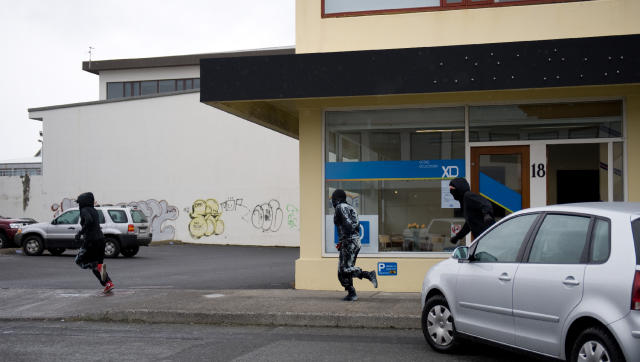
Yesterday, Friday August 7th, Saving Iceland protested by the Ministry of Industry. At the same time inside the building, a financial contract was signed between the
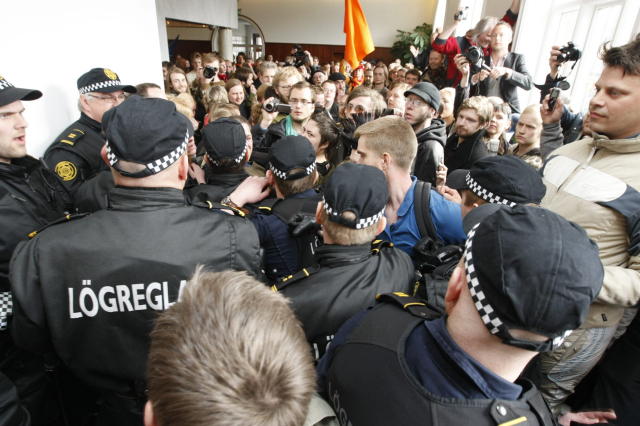
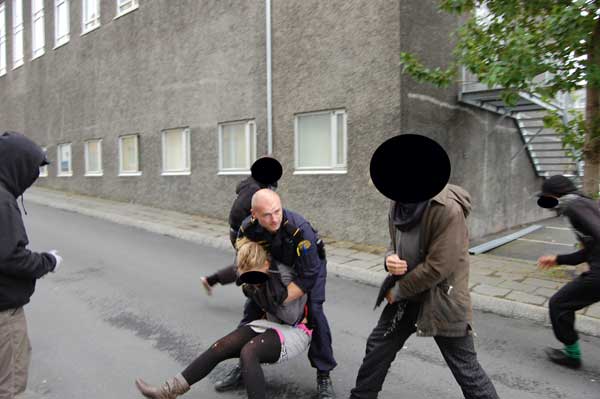
government and Norðurál/Century Aluminum, concerning the latter’s smelter in Helguvík. When the protest was about to end, the police showed up, arrested 5 individuals and aggressively roughed up one of them. Most of the media has spoken about the event but not mentioned the police brutality at all. Instead, the media has unsparingly published the police’s smear about us: that a policeman was kicked in the head and that we threatened the police with iron sticks, without any evidence showing that anything like this ever took place. Saving Iceland rejects these accusations and renounces the media’s one-sided reports.
The contract that was signed today includes state support for the aluminium smelters in the form of a tax discount that amounts to 16,2 million US dollars – two billion Icelandic krónur – and gives Norðurál/Century exemptions from paying industry fees, market fees and electricity safety fees. Special rules will also apply concerning stamp duty and planning fees, and about new taxes. The emission permits that are now valid permit a 150 thousand ton smelter in Helguvík; the Environmental Impact Assessment permits 250 thousand tons, but Century/Norðurál plans to build a 360 thousand ton smelter and today’s contract gives the company the right to do so. (1) The energy for the smelter has not been found and Svandís Svarvarsdóttir, the minister of environment has officially said that enough energy to run the smelter does not exist in the Reykjanes peninsula. At the same time, Katrín Júlíusdóttir, the minister of industry, has agreed with ideas about Landsvirkjun selling energy from the planned dams in Þjórsá river to Helguvík. (3) Read More
Aug 06 2009
Actions, ALCOA, Arms Industry, Corruption, Greenwash, Media bias, Saving Iceland
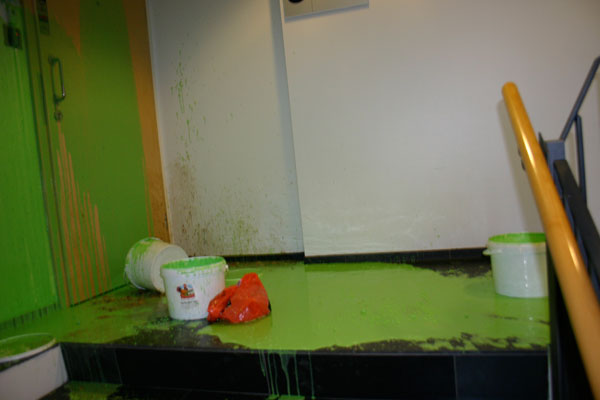
Last Tuesday, August 4th, Saving Iceland targeted the aluminium producer Alcoa. We knocked on the doors of the company’s office by Suðurlandsbraut but nobody answered, so the green skyr (traditional dairy product – historical for being used in protests) and other filthy stuff we had, ended up on the door, walls and the floor in front of the office. Compared to Alcoa’s role in the destruction of Iceland’s wilderness and other environmental and human crimes across the globe, this was a minimum punishment.
Though Alcoa’s aluminium smelter in Reyðarfjörður (east of Iceland) is now working with full force, driven on by the highly critical Kárahnjúkar Dam, there is still a fair reason for attacking the company. The smelter in Reyðarfjörður was the beginning of the heavy industry madness, the first sign of how effect the government’s advertisement campaign about the country’s cheap energy and people’s little as no resistance, was. (1) The smelter in Reyðarfjörður was the ball the pushed forward the idea that aluminium production is the premise for life. After the construction of the Kárahnjúkar Dam, all other energy projects look so small that only very few people seem to see a reason for fighting against them. And the police’s mistreatment towards those who dared to put their feet in between the construction, did for sure not encourage many to continue the resistance. Read More
Jul 29 2009
ALCOA, Andri Snaer Magnason, Century Aluminum, Economics, Landsvirkjun, Saving Iceland, Þjórsá
Shortly after the news about how Saving Iceland closed the offices of institutions and companies involved in the heavy industrialization of Iceland, Katrín Júlíusdóttir, the Minister of Industry said that she had not been able to study the message of Saving Iceland. She said that she had not received a written report from the group and not decided to contact it, but said that she takes a look at all factual comments that she receives. (1)
This is a typical answer for a politician or a corporation’s worker when his/her job is criticized. It is impossible to keep track of how many times Saving Iceland has been offered to sit down and chat with the spokespersons of companies like Landsvirkjun (Iceland’s national energy company) and political parties’ representatives. The purpose with these invitations to meetings is of course only to create a positive image of the corporation or the institution and give the idea that conversation and information are necessary parts of the business. When Saving Iceland has refused these offers, the movement has been stamped as non-factual and with a lack of knowledge, e.g. last summer when Landsvirkjun’s director, Friðrik Sophusson said the Saving Iceland was only asking for attention by acting like clowns. (2)
Katrín Júlíusdóttir knows just as well as Friðrik Sophusson what Saving Iceland’s message and aims are, and thus does not have to ask herself why the group did not wish to meet up with her. Environmentalists in Iceland – including Saving Iceland – have for years explained their resistance towards the heavy industrialization of Iceland with powerful information campaigns, publishing magazines and pamphlets, keeping up websites etc. etc. Most of Saving Iceland’s actions have been followed up with comprehensive press releases, including inconvenient facts about the companies that have to do with the heavy industrialization and information about the serious effects of aluminium production. These press releases have e.g. lead to the fact that the media coverage about the issue has widened. An example of that is the media coverage on the effects of bauxite mining and the aluminium companies’ connection and co-operation with arms producers and war institutions. (3) Read More
May 10 2009
ALCOA, Andri Snaer Magnason, Corruption, Economics, Landsvirkjun, Saving Iceland
Given the chance, we’d have made it into Murmansk
From The Reykjavík Grapvine – Dreamland is the result of collaboration between documentary filmmaker Þorfinnur Guðnason and author, playwright and poet Andri Snær Magnason. It is based on the latter’s best selling, award winning 2006 non-fiction book, ‘Dreamland: A self-help manual for a Frightened Nation’ (available in English translation through Amazon.co.uk and at local bookstores). The book stirred a lot of controversy in Iceland, as it shed new light on some of the issues surrounding the conflict between environmental preservation and the build up of heavy industry in Iceland. It furthermore examined the government’s hope to sell cheap energy from hydroelectric power plants in order to place Iceland among the world’s biggest aluminium manufacturers – and why on Earth we’d aspire to that.
The film goes even further, using the full potential of the medium to conjure up a truly chilling vision of recent events. And it’s effective. As we exited a screening of the film, my friend Geiri summarised the experience perfectly, saying: “Most of the time, I didn’t know whether to laugh, cry or vomit in disgust.” That somehow says it all. A scathing indictment of Iceland’s recent “all in” industrial and environmental policies, Dreamland combines archival news footage, exquisite nature shots and select interviews to achieve its goal of waking Icelanders up to the very real, very serious consequences of selling off some of the last bits of pristine wilderness remaining in Europe. Read More
Apr 25 2009
Actions, ALCOA, Century Aluminum, Corruption, Democracy deficit, Economic Collapse, Economics, Greenwash, Kárahnjúkar, Landsvirkjun, Media bias, Ólafur Páll Sigurdsson, Rio Tinto Alcan, Saving Iceland
Olafur Pall Sigurdsson
Saving Iceland applauds the symbolic hits that the three pro-heavy industry political parties were dealt in the form of liberal splashes of green skyr (traditional Icelandic dairy product) on Monday.
According to Saving Iceland’s sources, three different groups, not just one, like the corporate media have claimed, did these actions almost simultaneously. Saving Iceland has also been informed that the activists were all Icelandic. It appears that this is a powerful group of activists, fighting the heavy industrialization of Iceland. Saving Iceland declares full support with the group.
The forces that stand behind Sjálfstæðisflokkurinn (Conservatives), Framsóknarflokkurinn (Right-wing opportunists) and Samfylkingin (New Labour equivalents), are guilty of what is tantamount to high treason with their heavy industry policy. Judging from their election propaganda, there is no sign that the parties have been willing to learn anything from the economic collapse about the expansion effects on the economy by heavy industry.
At the same time as these parties’ policy of uncontrollable greed has been pursued with the consequences of immense irreversible destruction of the country’s unique nature, this policy has just as much harmed Icelandic society as a whole. Read More
Apr 07 2009
ALCOA, Alterra Power/Magma Energy, Andri Snaer Magnason, Century Aluminum, Corruption, Democracy deficit, Economic Collapse, Economics, Energy Prices, Geothermal Energy, Jaap Krater, Kárahnjúkar, Landsvirkjun, Reykjavik Energy, Rio Tinto Alcan, Saving Iceland
John Perkins, the author of
The Confessions of an Economic Hitman, is currently in Iceland. Perkins is here to be at the premier screening of
The Dreamland, a documentary based on Andri Snær Magnason’s book, also titled
The Dreamland. Last Sunday, Perkins was interviewed in a political TV show on RÚV (the state television station) where he spoke about the threat of Icelandic resources being sold to foreign corporations and advised Icelandic authorities not to collaborate with the International Monetary Fund (IMF).
Perkins used to work for the U.S. National Security Agency and his job included “to convince poor countries to accept enormous development loans – and to make sure that such projects were contracted to U.S. companies,” as says on the back cover of his book. Perkins states that Iceland is the first ‘developed’ country in the world to be hit by the ‘Economic Hitmen’, referring to the invasion of the aluminium industry in Iceland. Read More
Feb 09 2009
ALCOA, Bakki, Bechtel, Century Aluminum, Climate Change, Dams, Ecology, Economic Collapse, Energy Prices, Geothermal Energy, Greenwash, Hengill, hydropower, IMF, Kárahnjúkar, Landsvirkjun, Miriam Rose, Reykjavik Energy, Rio Tinto Alcan, Saving Iceland, Þjórsárver
From New Renaissance Magazine
By Miriam Rose
The economic issues currently causing mass demonstrations in Iceland have a less publicised ecological cousin, and one which the IMF has recently identified as part of the economic collapse. In 1995 the Ministry of Industry and Landsvirkjun, the national power company, began to advertise Iceland’s huge hydropower and geothermal energy potential. In a brochure titled “Lowest energy prices!!” they offered the cheapest, most hard working and healthiest labour force in the world, the cleanest air and purest water – as well as the cheapest energy and “a minimum of environmental red tape” to some of the world’s most well known polluting industries and corporations (such as Rio Tinto and Alcoa). This campaigning has led to the development of an ‘Energy Master Plan’ aimed at damming almost all of the major glacial rivers in Iceland, and exploiting all of the geothermal energy, for the power intensive aluminium industry. The loans taken by the Icelandic state to build large scale energy projects, and the minimal payback they have received from the industry, has been a considerable contributing factor to the economic crisis, while at the same time creating a European ecological crisis that is little heard of.
The Largest Wilderness in Europe
I first visited Iceland in 2006 and spent a week with activists from the environmental campaign Saving Iceland, a network of individuals from around Europe and Iceland who decry the fragmentation of Europe’s largest wilderness in favour of heavy industry. From these informed and passionate folk I learned of the 690 MW Kárahnjúkar dam complex being built in the untouched Eastern Central Highlands to power one Alcoa aluminium smelter in a small fishing village called Reydarfjörður. The dams formed the largest hydro-power complex in Europe, and were set to drown 57 km2 of beautiful and virtually unstudied wilderness, the most fertile area in the surrounding highlands. Ultimately it would affect 3% of Iceland’s landmass with soil erosion and river silt deprivation. They also explained how materials in the glacial silt transported to the oceans bonds with atmospheric CO2, sinking carbon. The damming of Iceland’s glacial rivers not only decreases food supply for fish stocks in the North Atlantic, but also negatively impacts oceanic carbon absorption, a significant climatic effect. After taking part in demonstrations at the construction site of the Alcoa smelter (being built by famous Iraq war profiteers Bechtel), I went to see the area for myself. Read More
Oct 26 2008
3 Comments
ALCOA, Century Aluminum, Economic Collapse, Economics, Energy Prices, Jaap Krater, Kárahnjúkar, Landsvirkjun, Norsk Hydro, Rio Tinto Alcan, Saving Iceland
Jaap Krater, Morgunblaðið, 26-10-2008
In times of economic crisis, it is tempting to embrace new megaprojects such as new power plants and aluminium smelters. But will this realistically improve Iceland’s economic prospects?
Prime minister Geir Haarde recently explained on Stöd 2’s chat show Mannamál that one of the main reasons for the fall of the Krona, was due to the execution of heavy industry projects: the construction of Kárahnjúkar and Alcoa’s smelter in Reyðarfjörður. If more large projects are executed, what will the cost be for the Icelandic taxpayer?
Haarde’s comments were not surprising. Before construction of Kárahnjúkar many economists predicted the negative impact on inflation, foreign debt and the exchange rate of the ISK.
Of course there is some economic benefit from new smelters, but “it is probably outweighed by the developments’ indirect impact on demand, inflation, interest rates and the ISK exchange rate,” stated a report by Glitnir in 2006 on the impact of aluminium expansion in Iceland. The report expected an increase in inflation and a depreciation of the ISK.
“Kárahnjúkar will never make a profit, and the Icelandic taxpayer may well end up subsidising Alcoa,” said the eminent economist Thorsteinn Siglaugsson after publishing another report on the profitability of the Alcoa dam in East Iceland before construction commenced. Read More