
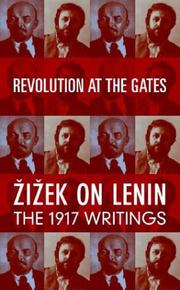
Revolution at our Gates Selected Writings of Lenin from 1917
De rooie rat is failliet, u kunt niet meer bestellen. ISBN: 9781859845462 Taal: Engels Jaar: 2010 Uitgever: Verso lenin filosofie politieke theorieThe idea of a Lenin renaissance might well provoke an outburst of sarcastic laughter. Marx is OK, but Lenin? Doesn't Lenin stand for the big catastrophe which left its mark on the entire twentieth-century world political scene, for the Real Socialist experiment which culminated in an economically inefficient dictatorship? Lenin, however, deserves wider consideration than this, and his writings of 1917 are testament to a formidable political figure. They reveal his ability to grasp the significance of an extraordinary moment in history - his instinctive understanding of the unique revolutionary chance. Everything is here, from Lenin-the-ingenious-revolutionary-strategist to Lenin-of-the-enacted-utopia. To use Kierkegaard's phrase, what we can glimpse in these writings is Lenin-in-becoming: not yet Lenin-the-Soviet-institution, but Lenin thrown into an open, contingent situation. Slavoj Zizek's major introduction situates the 1917 writings in their historical context, and tackles the key question of whether Lenin can be reinvented in our era of 'cultural capitalism'. Zizek is convinced: whatever the discussion - the forthcoming crisis of capitalism, the possibility of a redeeming violence, the falsity of liberal tolerance - he believes that Lenin's time has come again.
From the Back Cover
'After the Hungarian rebellion of 1956 was crushed by the Russian tanks, Georg Lukacs was taken prisoner; when a KGB officer asked him if he had a weapon, Lukacs calmly reached into his pocket and handed over his pen ... If ever a pen was a weapon, it was the pen which wrote Lenin's 1917 texts.' - from the Introduction
The idea of a Lenin renaissance might well provoke an outburst of sarcastic laughter. Marx is OK, but Lenin? Doesn't he stand for the big catastrophe which left its mark on the entire twentieth-century world political scene?
Lenin, however, deserves wider consideration than this, and his writings of 1917 are testament to a formidable political figure. They reveal his ability to grasp the significance of an extraordinary moment in history. Everything is here, from Lenin-the-ingenious-revolutionary-strategist to Leinin-of-the-enacted-utopia. To use Kierkegaard's phrase, what we can glimpse in these writings in Lenin-in-becoming; not yet Lenin-the-Soviet-institution, but Lenin thrown into an open, contingent situation.
Slavoj Zizek's Introduction situates the 1917 writings in their historical context, while his Afterword tackles the key question of whether Lenin can be reinvented in our era of 'cultural capitalism'. Zizek is convinced: whatever the discussion - the forthcoming crisis of capitalism, the possibility of a redeeming violence, the falsity of liberal tolerance - he believes Lenin's time has come again.
Gerelateerde boeken
 A Short Exposition. €15,00 |
 Resistance and Reform in the 21st Century. €22,50 |
 Tussen mythe en muziek. €19,95 |
 Lesbian and gay politics within the activist state. €4,50 |