
Review: The better Angels of our nature van Steven Pinker
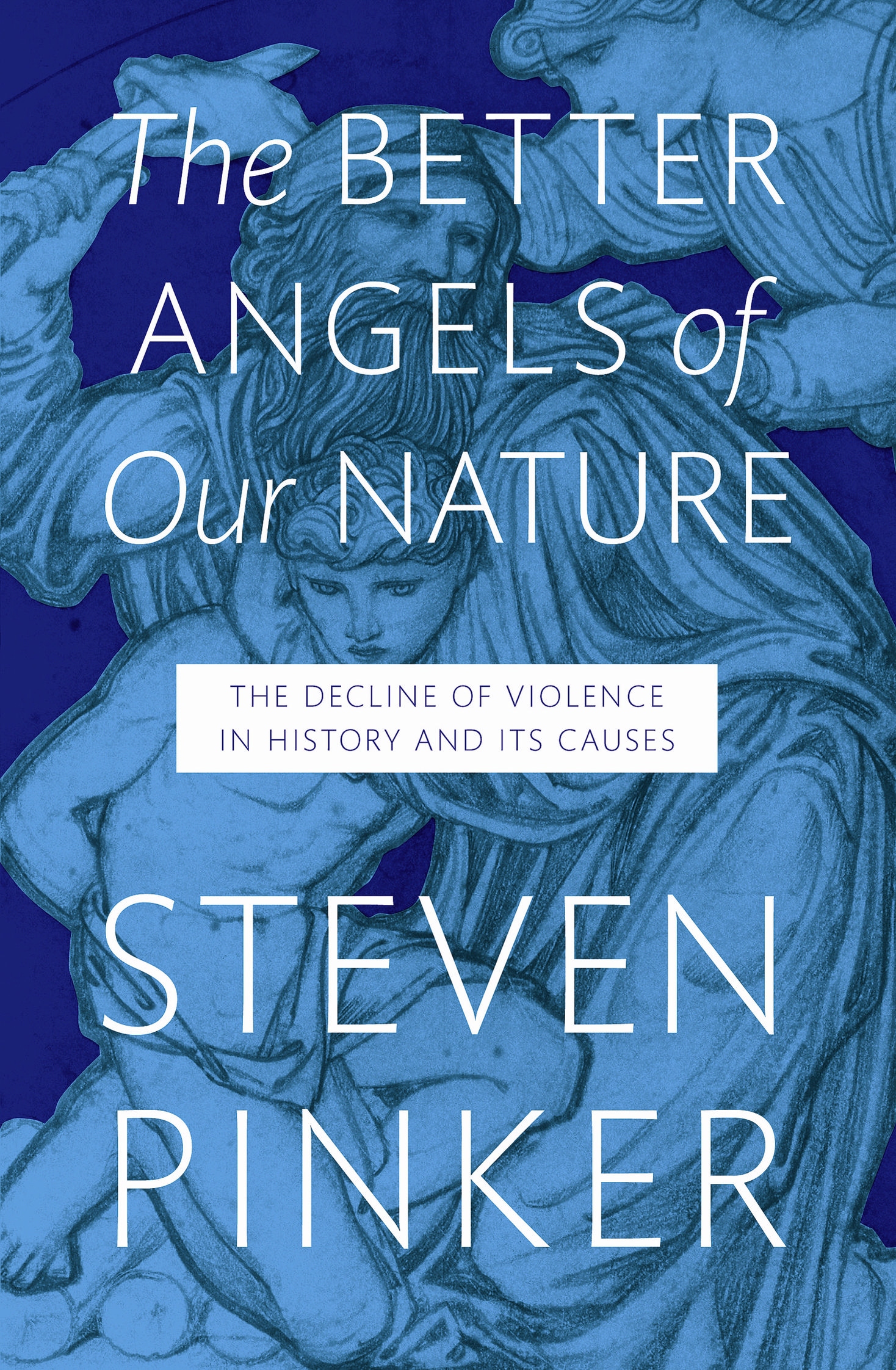
Soms is het zo dat recensies van boeken informatiever zijn dan het boek zelf. Dit is het geval in de zeer uitgebreide en gedetailleerde recensie van het boek The better angels of our nature van Steven Pinker door Edward Herman en David Peterson. In tegenstelling tot de positieve recensies die dit boek kreeg in onder andere de New York times and Wall Street Journal, is de conclusie van deze schrijvers is niet mals: “The Better Angels of Our Nature is an inflated political tract that misuses data and rewrites history in accord with its author’s clear ideological biases, while finding ideology at work only in the actions of his opponents. De oorzaak van Herman en Peterson’s ongenoegen is nu bij ons te koop.
Oorpronkelijk gepubliceerd op Z-net. Voor de volledige versie van de recensie (inclusief 240 voetnoten) klik hier
Concluding Note
Steven Pinker’s The Better Angels of Our Nature: Why Violence Has Declined is a terrible book, both as a technical work of scholarship and as a moral tract and guide. But it is extremely well-attuned to the demands of U.S. and Western elites at the start of the 21st century, with its optimistic message that the “better angels” of their nature are taking charge, and its lament over the other peoples of the world, whose “inner demons” and cultural backwardness have prevented them from keeping-up.
With his country engaged in a record-breaking number of simultaneous wars and interventions on four continents, with NATO expanding and asserting its military dominance globally, with Israeli settlement and dispossession policies unabated on the West Bank, with the United States and Israel threatening to attack Iran, and with some critics (not cited by Pinker) expressing profound concern over a deteriorating institutional environment in which it has become “hard to imagine any president or Congress standing up to the powerful vested interests of the Pentagon, the secret intelligence agencies and the military industrial complex,”[220] along comes Pinker bearing his 832-page gift on the declining relevance of war.
Pinker’s book also coincides with the surprising emergence of an Occupy Movement that is protesting a wide range of political, economic, and social developments that have increased human insecurity, inequality, and unemployment, filled U.S. prisons, and diminished the democratic substance of elections and political power. This is also a period in which civil liberties have been under serious attack, the right to Habeas Corpus suspended, torture openly employed and given legal sanction by the executive branch, and free speech rights of protest subject to increasing restriction.
The convenience of Pinker’s themes and the warm reception of his work reminds us of the similar treatment of Claire Sterling’s book The Terror Network back in 1981,[221] when her stress on an alleged Soviet responsibility for cross-border terrorism fit so well the Reagan administration’s intensified focus on terrorism and the threats posed by the “Evil Empire.” Sterling’s work was ludicrously sourced and biased (e.g., she had the Apartheid regime of South Africa combating the African National Congress’ and Nelson Mandela’s “terrorism,” but not itself engaging in terrorism), and easily shown to be intellectually indefensible,[222] but The Terror Network was given great attention and treated with respect in the media, and excerpts from it were published in establishment journals and presented as credible and authoritative.[223]
It is true that Pinker’s book employs a much larger scholarly apparatus, but this is a misleading façade. He relies heavily on the work of the International Peace Research Institute of Oslo (PRIO) as well as the Uppsala Conflict Data Program (UCDP)—two organizations whose findings largely overlap and, as we have seen, categorize the overwhelming U.S. role in the Afghan and Iraqi theaters of violence over the last decade as “secondary” to internal and “intercommunal” warfare.[224] Pinker also relies on the Vancouver-based Human Security Report Project (HSRP), whose work draws heavily from that of PRIO and UCDP, and whose interrelated themes of a decline in great-power violence and the “shrinking costs of war,” reversed in recent years by a surge in “Islamist political violence,”[225] fit well the foreign and domestic policies of the Western imperial powers.
Pinker relies also on the work of Matthew White, who in his own book on the worst atrocities in history asserts that the “Western philosophy of war-making tries to avoid killing civilians.” Under this philosophy, White explains, the “1945 atomic bombing of Hiroshima is justified as a legitimate act of war, while the 1983 suicide bombing of the U.S. Marine barracks in Beirut is condemned as terrorism.” The “key difference,” White adds, was that “one was performed openly against a declared enemy who had the opportunity to fight back or surrender, while the other was sneaky”[226]—that is, not an act of resistance to occupying armies that had just killed some 20,000 people and were still indiscriminately shelling the hills around Beirut. Pinker also relies on Rudolph Rummel’s work, a man who believes that Barack Obama is a left-wing appeaser of global tyrants, and busily engineering a coup d’état in the United States.[227] Rummel’s twin-volumes on “democide” are so badly deformed by bias that he estimated that all but 5,500 Vietnamese civilians killed by U.S. forces during the war were "collateral damage" and thus the unintended victims of a civilian-protective war policy, whereas North Vietnam had deliberately targeted and killed vastly greater numbers, all as a matter of policy.[228] Pinker himself claims that “at least 800,000 civilians died” in Vietnam, (267) but he also adds that these were “battle deaths,”[229] and that the deaths ultimately were a result of the Vietnamese Communists’ “fanatical dedication to outlasting their opponents”—that is, to their refusal to submit to superior force. (308)
Better Angels has been received even more warmly than was Claire Sterling’s book, garnering many positive reviews and its author invited to lecture about it and to appear on numerous radio, television, and Podcast interviews.[230] The New York Times treated the book to at least five prominent mentions prior to the flattering front-page account it received in the Sunday Book Review in early October 2011 by philosopher Peter Singer, in which Singer called it “supremely important“ and a “masterly achievement.”[231] Overall, the Times reviewed, excerpted, discussed, blogged, mentioned, or invited Pinker himself to reiterate its themes in more than 20 different items.[232] That was quite a positive push by the United States’ most prominent newspaper.
Even more noteworthy is the fact that so many liberals and leftists have been taken-in by Better Angels. The British philosopher Simon Blackburn praised the “riveting and myth-destroying” book, with its “positive history of humanity” and its “wealth of historical, anthropological and geographical data.”[233] The British political scientist David Runciman called it a “brilliant, mind-altering book,” and swallowed “Pinker’s careful, compelling account of why the 20th century does not invalidate his thesis that violence is in a long decline”—because the “violence of the 20th century is best understood as a series of random spasms,” according to Runciman, and because the “two world wars were essentially freak events, driven by contingency and in some cases lunacy.”[234] Both reviewers display the same inability or unwillingness to engage in serious institutional analysis as does Pinker.
In this country, Stephen Colbert had Pinker as a guest on his popular Comedy Central program, but asked him no serious questions; Pinker himself repeated without challenge his mantra that “we may be living in the most peaceful era in our species’ existence.”[235] Colbert did, however, find the courage to add that “Stalin killed 20 million people. Mao killed 70 million people. Hitler racked-up six million Jews alone and then like a cluster-of-millions of everybody else he didn’t care for….”
David Sirota also interviewed Pinker on his Colorado-based radio show. Sirota’s webpage at the KKZN radio station announces that Pinker’s book is “startling and engaging,” and adds in what appears to have been reproduced from the promotional literature of the Pinker camp that “Pinker shows (with the help of more than a hundred graphs and maps)…[that] we may be living in the most peaceful time in our species’ existence.”[236]
In introducing Pinker on his MSNBC show, The Nation’s Chris Hayes called Better Angels a “phenomenal book,” and added later that the book is “very persuasive that things are getting better, that humans are actually getting less violent.” Hayes asked no challenging questions about this book during his two-hour show. And in the show’s closing “You should know” segment, Pinker said that the audience should know that “The rate of death in war has been going down since 1946”—to which Hayes added that, yes, all of us “should know that it’s getting better, even in really bad weeks it’s getting better.”[237]
But do Colbert, Sirota, and Hayes (et al.) really go along with Pinker’s view that the 1960s was a decade of “decivilization,” and that the mushrooming of the U.S. prison population over the past 35 years is a sign of progress, as it further thinned the ranks of the Uncivilized roaming the streets? Do they accept that what those “overly indulgent” and future-discounting savages had suffered from was a lack of “self-control,” rather than adverse social conditions? And that the “recivilizing” process from the 1990s on—which included intensive policing, mass incarceration, and the reduction of welfare-state pampering—was the key to this improvement?
Do they also accept Pinker’s accolades to Charles Murray, Richard Herrnstein, James Q. Wilson, and Daniel Patrick Moynihan for emphasizing the alleged sociobiological roots of the class structure and inequality of U.S. society, and go along with his denunciations of the “hard-left” deniers of human nature whom,[238] in contrast to Pinker and his allies, have “radical” political agendas and want to protect the welfare state’s undermining of “self-control” and reversal of the “Civilizing Process”? Are they not aware that Pinker completely ignores the structural violence of the global class war that has increased inequality and interacted with systems of state violence to enlarge "internal security" operations and prison populations? That many of the Western so-called “democracies” are really national security states? And that Pinker classifies these as the advanced-guard of the “Civilizing Process”?
Do they accept that the post-World War II era was a “Long Peace,” and for Pinker’s reason that the great powers fought no wars among themselves? Do they buy-into Pinker’s view that the role of the United States in this era was merely the “containment” of an expansionist Communist enemy, and had no self-interested purpose or ideological base? Do they agree with his shifting of responsibility for Korean and Vietnamese civilian deaths in those distant wars from the United States to the communist sides? What do they think about Pinker’s citing the peace movements of the 1960s and during the run-up to the 2003 U.S. invasion of Iraq as evidence of the growth of our “better angels,” while failing to explain why those “angels” neither prevented nor stopped the wars? Could it be that institutional factors—the global interests of transnational corporations and the military-industrial complex, the refusal of the nuclear weapons-states to give up their advantage, a permanent-war system that is more resource-commanding than ever, and possesses the potential for unprecedented destruction—carry more weight in policy decisions than does the sociobiological expansion in the powers of reason and empathy speculatively asserted by Pinker, but impossible to prove?
Can they not see the inversion of reality in the notion that it is a “militant Islam” that is the cause of Western intervention in Islamic countries? And that the “Islamic threat” that Pinker elevates to ominous levels is contrived and, like Soviet “containment,” an excuse for a violent and forward-looking policy, necessary to meet Western institutional demands?
This critical failure to understand Pinker’s misrepresentations no doubt rests in part on the sheer volume of the purported evidence that he throws at his readers, with more than 1,950 endnotes, some 1,100 references, and roughly one figure for every six pages of text. But selectivity and ideological bias dominate throughout, and his key evidence does not withstand close scrutiny.
We have shown that Pinker’s most basic idea, that humans moved from a Hobbesian condition of chronic warfare via the growth of civilization and the Leviathan state to a slowly and unevenly developing peaceableness, is not sustained by credible evidence. In fact, the extant archaeological record flatly contradicts it, and in his review of Better Angels, the anthropologist Douglas P. Fry referred to this as “Pinker’s Big Lie.”[239] But without the counter-myth of the Violent Savage, there could be no “Pacification Process,” and his story about the “better angels of our nature” would take on an entirely different cast than the one he gives us, in which “human history contains an arrow” and “violence meanders downward.” (694)
Pinker calls the belief that the “twentieth century was the bloodiest in history” a “cliché” and an “illusion.” (193) He deals with the fact that World War II was the historical peak in war-related deaths, and World War I a big-time killer as well, by several tricks. One is to relativize deaths by adjusting the numbers killed in earlier conflicts to later and much larger population bases, so that although the absolute death toll from World War II tops all others, he can depict it as far less deadly than several other wars and conflagrations from centuries long ago. But while Pinker makes violence into a relative matter in order to prove his main theme, he often mentions the long historical diminution in violence without making explicit that he is talking about relative, not absolute, levels of violence. But increases in absolute levels of violence might well be independent of the sizes of the population base. Surely the U.S. attacks on Korea, Vietnam, and Iraq were rooted in independent factors, not the number of people then living on the planet. Nor was there any link between the Nazi holocaust and the population of China.
Another Pinker-device is to claim that the great wars of the 20th century were “random” events, and in his book’s many figures where he cannot avoid the deadliness of the First and Second World Wars, he waves-off their magnitude as "statistical illusions”—they are “outliers” and even “apparitions”—and he urges us to forget that they both occurred in the past 100 years. They are unrelated to “modernity,” whose “forces” for the “reduction of violence” remain sacrosanct in spite of these and subsequent wars—and the evident failure of the “better angels” to do their work.
Yet another trick is to start the "Long Peace" conveniently at the end of World War II, and to define it as a period in which there have been no wars between the great powers. But the First and especially the Second World War had taught them that with their advancing and life-threatening means of self-destruction, they could not go on playing their favorite game of mutual slaughter any longer. But this didn’t prevent them from carrying out numerous and deadly wars against the Third World, which filled-in the great-power war-gap nicely. Thus the “Long Peace”—a brief 67 years through 2012—has been peaceful only in a Pinkerian sense, and it appears to have very shallow or even no roots in our “better angels.” Furthermore, as we have stressed, it is increasingly threatened by a Western elite-instigated global class war and a permanent-war system fueled by “threats” manufactured by institutional structures that continue to overwhelm these “better angels.”
In the final analysis, The Better Angels of Our Nature is an inflated political tract that misuses data and rewrites history in accord with its author’s clear ideological biases, while finding ideology at work only in the actions of his opponents. Pinker fears that readers will find his book “Whiggish and presentist and historically naïve,” (692) but this secular theodicy is animated by the spirit of Dr. Pangloss more than anyone else,[240] and with its deep commitments to an elitist, Western-imperial point of view, it transcends even Voltaire’s character in the fantasy that everything done by the Holy State and its minions is leading to the best of all actual worlds.
Small wonder, then, that the message of Better Angels pleases so well the editors of the New York Times and the large U.S. permanent-war establishment. It is regrettable that despite its manifest problems, the book has bamboozled so many other people who should know better.