
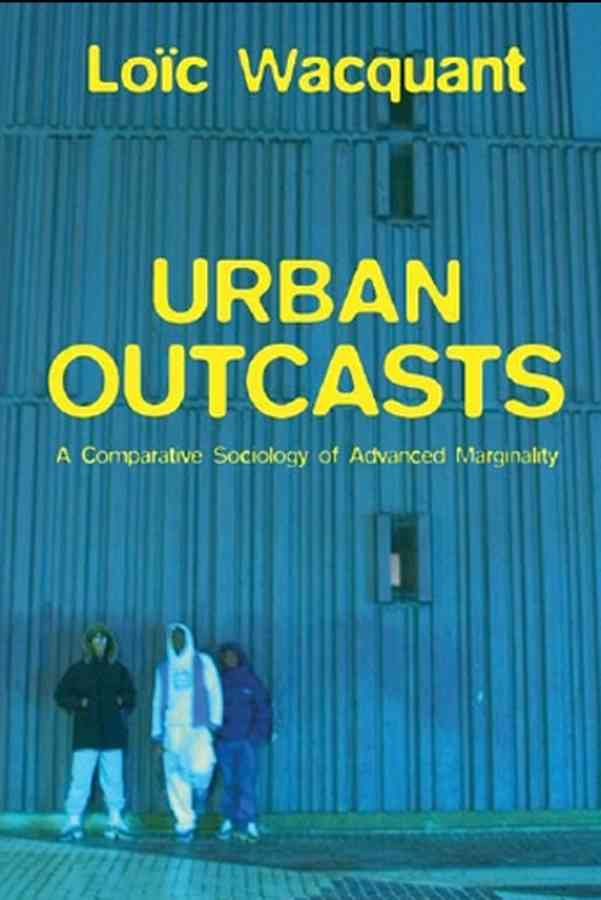
Urban Outcasts. Comparative Sociology of Advanced Marginality
De rooie rat is failliet, u kunt niet meer bestellen. ISBN: 9780745631257 Taal: Engels Jaar: 2011 Uitgever: Polity Press politieke theorie armoede sociologieBreaking with the exoticizing cast of public discourse and conventional research, Urban Outcasts takes the reader inside the black ghetto of Chicago and the deindustrializing banlieue of Paris to discover that urban marginality is not everywhere the same. Drawing on a wealth of original field, survey and historical data, Loïc Wacquant shows that the involution of America's urban core after the 1960s is due not to the emergence of an 'underclass', but to the joint withdrawal of market and state fostered by public policies of racial separation and urban abandonment. In European cities, by contrast, the spread of districts of 'exclusion' does not herald the formation of ghettos. It stems from the decomposition of working-class territories under the press of mass unemployment, the casualization of work and the ethnic mixing of populations hitherto segregated, spawning urban formations akin to 'anti-ghettos'.
Comparing the US 'Black Belt' with the French 'Red Belt' demonstrates that state structures and policies play a decisive role in the articulation of class, race and place on both sides of the Atlantic. It also reveals the crystallization of a new regime of marginality fuelled by the fragmentation of wage labour, the retrenchment of the social state and the concentration of dispossessed categories in stigmatized areas bereft of a collective idiom of identity and claims-making. These defamed districts are not just the residual 'sinkholes' of a bygone economic era, but also the incubators of the precarious proletariat emerging under neoliberal capitalism.
Urban Outcasts sheds new light on the explosive mix of mounting misery, stupendous affluence and festering street violence resurging in the big cities of the First World. By specifying the different causal paths and experiential forms assumed by relegation in the American and the French metropolis, this book offers indispensable tools for rethinking urban marginality and for reinvigorating the public debate over social inequality and citizenship. --This text refers to the Hardcover edition.
Synopsis
Takes readers inside the black ghetto of Chicago and the deindustrializing banlieue of Paris to discover that urban marginality is not everywhere the same. This book sheds light on the mix of misery, affluence and street violence resurging in the big cities of the First World.
Ghetto, Banlieue, Favela, et caetera: Tools for Rethinking Urban Marginality 1
Ghetto, banlieues, state
2
Towards a comparative sociology of urban marginality
7
Prologue: An Old Problem in a New World? 13
1 The Return of the Repressed: Riots, 'Race' and Dualization in Three Advanced Societies
15
Violence from below: race riots or bread revolts?
18
Violence from above: deproletarianization, relegation, stigmatization
24
Political alienation and the dilemmas of penalization
30
Coda: a challenge to citizenship
37
Part I From Communal Ghetto to Hyperghetto 41
2 The State and Fate of the Dark Ghetto at Century's Close
43
From race riots to silent riots
44
Farewell to the eternal ghetto
46
Three preliminary caveats
48
From the 'communal ghetto' of the 1950's to the 'hyperghetto' of the 1990's
51
Physical decay and danger in the urban core
53
Depopulation, deproletarianization and organizational folding
57
'Hustling' and everyday subsistence in the informal economy
62
Economic and political roots of hyperghettoization
69
Disinvestment, polarized growth and the racial segmentation of deskilled labour
70
Racial segregation, housing policy and the concentration of black poverty
75
The retrenchment of the miserly welfare state
80
Political marginality and the 'planned shrinkage' of the inner city
83
Conclusion: political reconfigurations of racial domination
89
3 The Cost of Racial and Class Exclusion in 'Bronzeville'
92
Deindustrialization and hyperghettoization
95
The cost of living in the hyperghetto
103
1 Class structure at the core and rim of the ghetto
105
2 Class, gender and welfare trajectories
108
3 Differences in economic and financial capital
111
4 Social capital and poverty concentration
114
Conclusion: social structuring of poverty in the hyperghetto
117
4 West Side Story: A High-Insecurity Ward in Chicago
119
State poverty and street capitalism
121
The grisly lottery of homicides
126
'Six feet under the ground or in jail'
130
Part II Black Belt, Red Belt 133
5 From Conflation to Comparison: How Banlieues and Ghetto Converge and Contrast
135
The moral panic of the 'cit ghettos'
137
Working-class banlieues are not US-style ghettos
145
Surface similarities in morphological evolution and lived experience...
145
...mask deep differences of scale, structure and function
150
1 Disparate organizational ecologies
150
2 Racial cloistering and uniformity versus ethnic dispersion and diversity
152
3 Divergent rates and degrees of poverty
155
4 Criminality and dangerousness
156
5 Urban policy and the degradation of daily surroundings
158
Conclusion: the 'French ghetto', a sociological absurdity
160
6 Stigma and Division: From the Core of Chicago to the Margins of Paris
163
The 'Americanization' of poverty in the European city?
165
Territorial stigmatization: experience, roots and effects
169
'It's like you got the plague here'
170
'People really look down on you'
174
From spatial stigmatization to social dissolution
178
Social vision and division in ghetto and banlieue
185
American apartheid and split racial consciousness
185
'Jeunes des cit against the rest of the world
188
The intermingling of categories, collective trajectories and 'ethnic' tensions
190
Conclusion: the mental structures of marginality
197
7 Dangerous Places: Violence, Isolation and the State
199
Comparing urban trenches
200
Delinquency, street violence and the shrinking of public space
204
Youth delinquency and the feeling of insecurity in Red Belt cites
205
Street violence and the shrivelling of public space on Chicago's South Side
209
Institutional isolation versus organizational desertification
213
Organizational density and institutional isolation in the Quatre mille
214
Public-sector dereliction and the organizational desertification of the ghetto
218
Conclusion: reaffirming the obligations of the state
224
Part III Looking Ahead: Urban Marginality in the Twenty-First Century 227
8 The Rise of Advanced Marginality: Specifications and Implications
229
'Underclass' and 'banlieue': the faces of advanced marginality
229
Six distinctive properties of the rising regime of marginality
233
1 Wage labour as vector of social instability and life insecurity
234
2 Functional disconnection from macroeconomic trends
236
3 Territorial fixation and stigmatization
237
4 Spatial alienation and the dissolution of 'place'
241
5 Loss of hinterland
243
6 Social fragmentation and symbolic splintering, or the unfinished genesis of the 'precariat'
244
Implications for urban theory and research
247
Towards a revolution in public policy
252
9 Logics of Urban Polarization from Below
257
Symptoms of advanced marginality in the city
260
Four structural logics fuel the new urban poverty
262
1 Macrosocial dynamic: occupational dualization and the resurgence of inequality
263
2 Economic dynamic: the desocialization of wage labour
265
3 Political dynamic: the recoiling of the social state
267
4 Spatial dynamic: concentration and defamation
270
The spectre of transatlantic convergence exorcized
272
Coping with advanced marginality: the turn to the penal state
276
Postscript: Theory, History and Politics in Urban Analysis 280
Acknowledgements and Sources 288
References 291
Index 330
Gerelateerde boeken
 Een andere verhalen uit de rechtbank Utrecht. €15,00 |
 De Germania en de opkomst van het nazisme. €24,99 |
 €19,95 |
 €10,00 |