
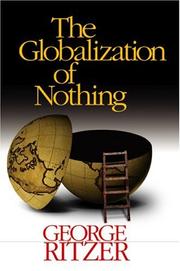
The Globalization of Nothing
De rooie rat is failliet, u kunt niet meer bestellen. ISBN: 9780761988076 Taal: Engels Jaar: 2003 Uitgever: Sage globalisering sociologieIn a world increasingly festooned with familiar logos ? from the hallmark swoosh on a designer tennis shoe to an amusement park?s infamous mouse ears ? it is clear that these symbols are not merely decorative, but represent important changes in our social milieu. The proliferation of credit card offers, automated banking services, and globally recognizable brand names illustrate significant changes in the realm of social consumption: a trajectory toward a world of increasingly dehumanized services and empty places and things.
George Ritzer theorizes in his provocative new book, The Globalization of Nothing, that the "grand narrative" or social story of this period is a movement from "something" to "nothing." Building on but going beyond his renowned McDonaldization thesis, Ritzer contends that societies around the globe continue to move away from "something," defined as a social form that is generally indigenously conceived, locally controlled, and rich in distinctive content. He argues that we are moving toward "nothing" ? that which is centrally controlled and conceived and relatively devoid of distinctive substance. It is in the movement toward the globalization of "nothing" that "something" is lost. More than likely, that "something" is an indigenous custom, a local store, a familiar gathering place, or simply personalized interaction. Thus, the central problem in the world today is defined as "loss amidst monumental abundance (of nothing)."
The Globalization of Nothing takes the subject of globalization in new directions, introducing terms such as "grobalization" (the growing influence of, for example, American corporations throughout the world). The key conflict in the world today is viewed as that between the grobalization of nothing and the glocalization of something. This book is structured around four sets of concepts addressing this issue: "places/non-places," "things/non-things," "people/non-people," and "services/non-services." By drawing upon salient examples from everyday life, George Ritzer invites the reader to examine the nuances of these concepts in conjunction with the paradoxes within the process of the globalization of nothing. Why is it that those who produce "nothing" for major multinational corporations often cannot afford that which they produce? Why do so many of us seem to be enraptured with our favorite brands or with our credit cards? What are the social implications of the increasing "globalization of nothing" for medicine, education, and tourism? Critical questions are raised throughout the book and the reader is compelled not only to seek answers to these questions, but to critically evaluate the questions as well as their answers.
The Globalization of Nothing is ideal as a primary or supplemental text for courses in sociology, anthropology, communication, business, and related disciplines. This book is also recommended for anyone interested in the critical study of contemporary social phenomena.
Gerelateerde boeken
 Urban Visual Culture in 1920s Germany. €24,90 |
 Workers' Movements and Globalization since 1870. €27,50 |
 €25,00 |
 €39,50 |