
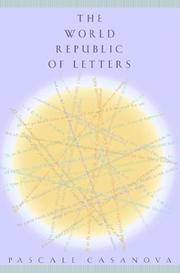
The World Republic of Letters Translated by M. B. DeBevoise
De rooie rat is failliet, u kunt niet meer bestellen. ISBN: 9780674013452 Taal: Engels Jaar: 2005 Uitgever: Harvard UP filosofieThe "world of letters" has always seemed a matter more of metaphor than of global reality. In this book, Pascale Casanova shows us the state of world literature behind the stylistic refinements--a world of letters relatively independent from economic and political realms, and in which language systems, aesthetic orders, and genres struggle for dominance. Rejecting facile talk of globalization, with its suggestion of a happy literary "melting pot," Casanova exposes an emerging regime of inequality in the world of letters, where minor languages and literatures are subject to the invisible but implacable violence of their dominant counterparts.
Inspired by the writings of Fernand Braudel and Pierre Bourdieu, this ambitious book develops the first systematic model for understanding the production, circulation, and valuing of literature worldwide. Casanova proposes a baseline from which we might measure the newness and modernity of the world of letters--the literary equivalent of the meridian at Greenwich. She argues for the importance of literary capital and its role in giving value and legitimacy to nations in their incessant struggle for international power. Within her overarching theory, Casanova locates three main periods in the genesis of world literature--Latin, French, and German--and closely examines three towering figures in the world republic of letters--Kafka, Joyce, and Faulkner. Her work provides a rich and surprising view of the political struggles of our modern world--one framed by sites of publication, circulation, translation, and efforts at literary annexation.
Introduction: The Figure in the Carpet
I. THE LITERARY WORLD
1. Principles of a World History of Literature
The Bourse of Literary Values
Literature, Nation, and Politics
2. The Invention of Literature
How to "Devour" Latin
The Battle over French
The Cult of Language
The Empire of French
The Herderian Revolution
3. World Literary Space
Roads to Freedom
The Greenwich Meridian of Literature
Literary Nationalism
National versus International Writers
Forms of Literary Domination
4. The Fabric of the Universal
The Capital and Its Double
Translation as Littérarisation
Language Games
The Importance of Being Universal
Ethnocentrisms
Ibsen in England and in France
5. From Literary Internationalism to Commercial Globalization?
II.. LITERARY REVOLTS AND REVOLUTIONS
6. The Small Literatures
Literary Destitution
Political Dependencies
National Aesthetics
Kafka and the Connection with Politics
7. The Assimilated
Naipaul: The Need to Conform
Michaux: What Is a Foreigner?
Cioran: On the Inconvenience of Being Born in Romania
Ramuz: The Impossible Assimilation
8. The Rebels
Literary Uses of the People
National Tales, Legends, Poetry, and Theater
Legacy Hunting
The Importation of Texts
The Creation of Capitals
The International of Small Nations
9. The Tragedy of Translated Men
Thieves of Fire
Translated from the Night
Comings and Goings
Kafka: Translated from Yiddish
Creators of Languages
Literary Uses of the Oral Language
Andrade: The Anti-Camões
Swiss Creoleness
10.. The Irish Paradigm
Yeats: The Invention of Tradition
The Gaelic League: Recreation of a National Language
Synge: The Written Oral Language
O'Casey: The Realist Opposition
Shaw: Assimilation in London
Joyce and Beckett: Autonomy
Genesis and Structure of a Literary Space
11.. The Revolutionaries
Dante and the Irish
The Joycean Family
The Faulknerian Revolution
Toward the Invention of Literary Languages
Conclusion: The World and the Literary Trousers
Notes
Index
Gerelateerde boeken
 18th-century bluestockings. €26,95 |
 See The World From a Different Angle. €49,75 |
 Van Rurik tot Poetin. Geheel herziene druk. €32,50 |
 Applying Philosophy in Politics and Culture. €6,50 |