
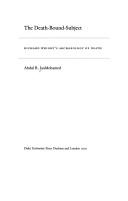
The Death-Bound-Subject Richard Wright's Archaeology of Death
De rooie rat is failliet, u kunt niet meer bestellen. ISBN: 9780822334880 Taal: Engels Jaar: 2005 Uitgever: Duke UP marx filosofie black powerDuring the 1940s, in response to the charge that his writing was filled with violence, Richard Wright replied that the manner came from the matter, that the ?relationship of the American Negro to the American scene [was] essentially violent,? and that he could deny neither the violence he had witnessed nor his own existence as a product of racial violence. Abdul R. JanMohamed provides extraordinary insight into Wright's position in this, the first study to explain the fundamental ideological and political functions of the threat of lynching in Wright's work and thought. JanMohamed argues that Wright's oeuvre is a systematic and thorough investigation of what he calls the death-bound-subject, the subject who is formed from infancy onward by the imminent threat of death. He shows that with each successive work, Wright delved deeper into the question of how living under a constant menace of physical violence affected his protagonists and how they might ?free? themselves by overcoming their fear of death and redeploying death as the ground for their struggle.
Drawing on psychoanalytic, Marxist, and phenomenological analyses, and on Orlando Patterson's notion of social death, JanMohamed develops comprehensive, insightful, and original close readings of Wright's major publications: his short-story collection Uncle Tom's Children; his novels Native Son, The Outsider, Savage Holiday, and The Long Dream; and his autobiography Black Boy/American Hunger. The Death-Bound-Subject is a stunning re-evaluation of the work of a major twentieth-century American writer, but it is also much more. In demonstrating how very deeply the threat of death is involved in the formation of black subjectivity, JanMohamed develops a methodology for understanding the presence of the death-bound-subject in African American literature and culture from the earliest slave narratives forward.
?This is a path-breaking, imaginative, comprehensive, indeed magisterial, analysis of the ways in which death functions in the construction of black subjectivities in Richard Wright's fiction, autobiographies, and journalism. It both expands our understanding of Wright's achievement and models a way in which the spectre of violence, lynching, and death may be seen to shadow and shape a trajectory of African American cultural production.??Valerie Smith, author of Not Just Race, Not Just Gender: Black Feminist Readings
?Abdul JanMohammed reworks the concept of 'social death' to read Richard Wright in comprehensive and provocative ways. At the same time, he offers a new account of slavery, rewriting Hegel and psychoanalysis along the way, to rewrite 'lordship and bondage' as the 'death contract' and to discern the precise and various ways in which autonomy and freedom are asserted. This book is enormously impressive in its sweep, its detailed consideration of Wright's corpus, it theoretical ambitions, and the new and compelling paradigms it offers for rethinking slavery, death, and resistance.??Judith Butler, Maxine Elliott Professor at the University of California, Berkeley
Abdul R. JanMohamed is Professor of English at the University of California, Berkeley. He is the author of Manichean Aesthetics: The Politics of Literature in Colonial Africa and a coeditor of The Nature and Context of Minority Discourse.
Gerelateerde boeken
 Opgravingen vertellen een ander verhaal. €24,90 |
 Opvoeding in Marokkaanse en Turkse gezinnen. €17,50 |
 Kritische studies van de pedagogische actualiteit. €27,50 |
 essay over de exterioteit €45,80 |