
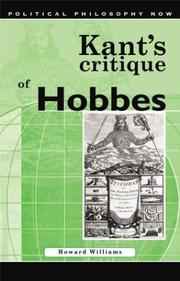
Kant's Critique of Hobbes Sovereignty and Cosmopolitanism
De rooie rat is failliet, u kunt niet meer bestellen. ISBN: 9780708318140 Taal: Engels Jaar: 2003 Uitgever: Univ. of Wales Press filosofieIn Leviathan (1651), Thomas Hobbes lays out the theoretical basis of the Westphalian Order ? dominant in European politics from the treaty of Westphalia in 1648 until the end of WWII ? in which sovereign and absolutist national states compete against each other for power and influence. In opposition to Hobbes, Immanuel Kant develops a theory of cosmopolitan right in which state sovereignty is matched with a gradually developing world federation of free states. Similarly, Kant opposes Hobbes?s in egotistic moral theory with a moral theory which is based on the self and the community.
Kant?s Critique of Hobbes is a unique systematic study of the relationship between the two thinkers. In it, Howard Williams demonstrates the viable alternative to Hobbes? orthodoxy that can be found in Kant?s political writings. Looking closely at the main concepts that are in contention in Kant?s relationship with Hobbes ? freedom, equality and independence ? the book sheds new light on ideas that lie at the foundations of contemporary political order. Williams shows also how Kant helps anticipate the development of a world-wide political system and suggests that through Kant?s political philosophy, the sovereignty of the individual state and cosmopolitanism (world-citizenship) can be brought into agreement.
Howard Williams holds a personal chair in Political Theory in the department of International Politics at the University of Wales, Aberystwyth and is the general editor of the Political Philosophy Now series. He is the author of many books and articles, including Kant?s Political Philosophy (1983), Concepts of Ideology (1988), International Relations and the Limits of Political Theory (1996) and Francis Fukuyama and the End of History (with D. Sullivan and G. Matthews, 1997).
. . . an excellent introduction to the main principles of Kant's own political philosophy . . . The book is clearly written, the arguments eminently accessible and the text well documented . . . The appearance of the work is timely: the increase of terrorism as a political weapon on a world wide scale may well shift the focus of political philosophy from the defence of the liberal agenda as found in the works of John Rawls to threats to our security. A shift from Locke and Kant to Hobbes. All the more reason why we should be reminded of what is at stake when the terrorist threatens our security and if and when methods used to defeat the terrorist such as the use of pre-emptive strikes against the terrorist threatens our civil liberties.? D. O. Thomas
Gerelateerde boeken
 Wie doet eraan mee en wanneer hebben ze effect. €10,00 |
 €10,00 |
 Opsporing en vervolging in 2006. €1,00 |
 Reconstructie van een politieke aardschok. €20,00 |