
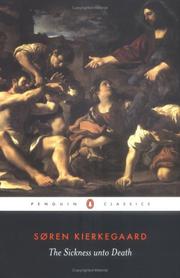
The Sickness unto Death A Christian Psychological Exposition for Edification and Awakening by Anti-Climacus
De rooie rat is failliet, u kunt niet meer bestellen. ISBN: 9780140445336 Taal: Engels Jaar: 2004 Uitgever: Penguin filosofie religieThe Sickness Unto Death is famed for the depth and acuity of its modern psychological insights. Writing under the pseudonym Anti-Climacus, Kierkegaard explores the concept of 'despair', alerting readers to the diversity of ways in which they may be described as living in this state of bleak abandonment - including some that may seem just the opposite - and offering a much-discussed formula for the eradication of despair. This late work was hugely influential upon twentieth-century philosophers including Jaspers, Sartre and Camus and it can be regarded as one of the key works of theistic existentialist thought.
If you really want to know where modernity's notion of despair claims it genesis then read the "Sickness Unto Death" It was Kierkegaard who coined despair as a "sickness unto death" and as a sickness of the self. Kierkegaard himself lived a life full of death, sadness, melancholy and malaise, so it comes to no surprise that he would write about despair. The Sickness Unto Death is all about despair, its different forms, how it manifests itself, where it comes from and how it is related to sin. It is a Christian dialectic on despair in man. Kierkegaard imitates Socrates, dialectically extrapolating despair in a constant interplay between relation and misrelation. Man is a synthesis of infinitude and finitude. But often a misrelation occurs and man is unaware of being in despair. That is despair's specific character, that it is unaware of itself. No one wants to be in despair. Kierkegaard's grim conclusion is that most of us conceal our despair. Christian or not, everyone has despaired, and in some extent, at any point in one's life, is still in some degree in despair according to Kierkegaard. Persons of skewed immediacy and misdirected reflections: their immediacy conceals despair, conceals the infinite within. He cannot pinpoint his pain because he has no self; he has no self that he is aware. He is immediacy. Reflection can help. Though, reflection is not the antidote in of itself; it will not save you alone. Life is absurd. Man has lost love. Man has fallen into despair and sin because of his weakness. Despair as weakness equates to sin. Kierkegaard is right in his dialectic: we conceal a deeper, infinitely related despair, but the problem is how deep can we know our own despair? Kierkegaard's book, while it may be a little dry, is great for getting a head start in understanding a condition that seems to be universal: for those who believe in a god and those who don't. Heidegger would call it everydayness, some contemporaries call it malaise. Kierkegaard called it the sickness unto death. Once you get past the first chapter the rest falls into place. If you allow Kierkegaard to speak to you, allow the text to open your mind to a greater awareness of self then I think you will be blessed. You may, though, be just as lost as before you read the book -- but if you are looking for a great philosophical work on despair ... not fluff or mush ... but something substantial, not your everyday, malaise ridden dime novel, but hard core, concise, dialectically composed text, then go for Soren Kierkegaard "The Sickness Unto Death".
Translation, introduction and notes by Alastair Hannay.
Gerelateerde boeken
 Confrontaties en bespiegelingen. €22,50 |
 Omzwervingen van een Koerdische familie. €6,50 |
 €25,00 |
 De Nederlandse sociaal-democratie en het nationaal socialisme, 1922-1940 €24,95 |