
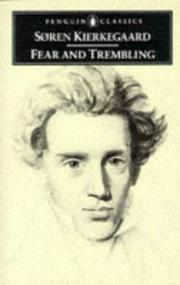
Fear and Trembling Dialectical Lyric by Johannes de Silentio. Translated and Introduction by Elistair Hannay
De rooie rat is failliet, u kunt niet meer bestellen. ISBN: 9780140444490 Taal: Engels Jaar: 2003 Uitgever: Penguin filosofieSoren Kierkegaard is regarded by many as the founder of the existentialist movement that rose to prominence in twentieth century literature in the form of the novels of Franz Kafaka, Albert Camus, Jean-Paul Sartre, and the philosophical works of Martin Heidigger, to name but a few figures.
Written after the seminal 'Either/Or', this psychological exposition is nevertheless central to the Kierkegaard cannon. In Kierkegaard's 'dialetical' style, the book explores the biblical account of Abraham, passionately exploring the tremulous psychology of the moments leading up to, and, most importantly, at the point of, Abraham's sacrifice of Isaac. Alertly conscious of the futility of his age, almost prophetic in his anticipation of much of the soul-searching of the twentieth century, the book never becomes a boring theological treatise; rather, Kierkegaard seeks to involve the reader in an understanding of Abraham, who he terms a "knight of faith". In stressing the importance of the individual himself acting with the honesty that his freedom demands, Kierkegaard challenges the reader to place himself on a parallel with Abrham who "transcends the finite to the infinite, before assuming incidentally the finite".
The book is well written, unlike many philosophical works; one does not has to pause and dwell upon each paragraph, searching for comprehension, for Kierkegaard employs a technique known as "repetition", re-phrasing his argument from a slightly different angle at several points, often repeating an exact phrase several times, on each occasion arguing logically to a further point. Paradox is pivotal to Kierkegaard's psychological examinations, and is brilliantly reflected by the pulsating tempo of his writing; the depth of the text is greatly increased by regular darting references to other works, Shakespeare's tragedies, and the work of classical dramatists particularly strongly emphasised.
The strength of the book lies principally, as in much of Kierkegaard's work, in the fact that it is heavily autobiographical, even if that element is metaphorically disguised - there is always a marked sincerity to his observations.
Kierkegaard can digress slightly, and this is the main critiscism of the novel - nevertheless, this flaw often becomes a strength, as the aphorisms that express the profundity of his philosophical refelctions, are merely heightened in emphasis amongst the psychological reasoning that surrounds them. Any understanding of existentialism must include Kierkegaard, and this book is certainly a core text for such an undertaking.
Gerelateerde boeken
 An Anthology of Anarchism. book 1. €19,90 |
 €12,50 |
 574 kilometer fietsplezier van de Limburgse heuvels naar het Groningse wad. €9,00 |
 Beyond Structuralism and Hermeneutics. €23,00 |