
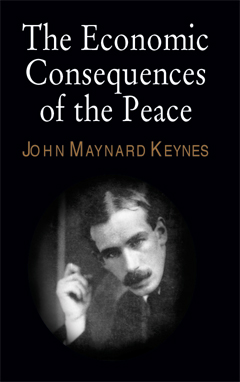
The Economic Consequences of the Peace
De rooie rat is failliet, u kunt niet meer bestellen. ISBN: 9780486434506 Taal: Engels Jaar: 2007 Uitgever: Dover Books politieke theorie (burger-) oorlog politieke economieFor Keynes, the Peace Treaty of Paris after World War I was a matter of life and death, of starvation and existence, and the fearful convulsions of a dying civilization.
But the negotiating politicians had absolutely no vision. Clemenceau wanted a Carthaginian peace, President Wilson was essentially a theologian and Lloyd George yielded to national electoral chicane.
The victors had no magnanimity. `The future life of Europe was not their concern; its means of livelihood was not their anxiety. Their preoccupations related to frontiers and nationalities, to imperial aggrandizements, to the future enfeeblement of a strong and dangerous enemy, to revenge and to the shifting of their unbearable financial burden on to the shoulders of the defeated.
But for Keynes, the policy of reducing Germany to servitude for a generation was abhorrent and detestable: `Nations are not authorized, by religion or natural morals, to visit on the children of their enemies the misdoings of parents or of rulers.'
Keynes had the decency to leave the negotiations from the moment he saw the looming disastrous results.
Keynes brilliantly calculated that Germany could not pay the imposed debt. He foresaw the coming German hyperinflation. He clearly recognized the danger of `a victory of reaction' (the right) in Germany, because it would endanger the security of Europe and the basis of peace.
Eventually that's what happened with all its disastrous consequences for Europe.
His prediction of millions of dead from starvation in Germany didn't occur.
Gerelateerde boeken
 Een politiek-psychologisch essay. €21,00 |
 The Truth about Economic Hit Men, Jackals, and How to Change the World. €15,95 |
 Islam, Human Rights, and Comparative Ethics. €26,00 |
 Agent Provocateur. €29,00 |