
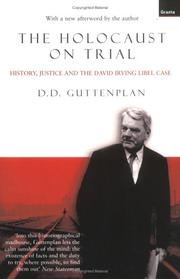
The Holocaust on Trial History, Justice and the David Irving Libel Case. With a New Afterword by the Author
De rooie rat is failliet, u kunt niet meer bestellen. ISBN: 9781862074866 Taal: Nederlands Jaar: 2002 Uitgever: Granta geschiedenis recht algemeen fascismeDD Guttenplan's choice of David Irving's libel suit against Deborah Lipstadt and Penguin Books as subject matter for his first book, The Holocaust on Trial, proves a challenging but ultimately justified one. Guttenplan, an American writer now living in London, sat through every day of the trial in 1999. At stake were two things of varying importance: the position in law of the Holocaust and its definable constituents, and the reputation of David Irving. Irving was suing the defendants for remarks in Lipstadt's book, Denying the Holocaust which, he claimed, falsely labelled him a Holocaust denier. His argument was that while he did not believe there had been a systematic murder of Jews, and questioned the existence of gas chambers at Auschwitz for such a purpose, he did not deny that millions had met their deaths. The result was nine weeks of intense and wide-searching debate, which saw history, and historiography, very much on trial.
In a way, it was a strange performance. The female lead, so to speak, did not have a single line, and the decision to dispense with a jury left narrative gaps for Guttenplan to colour in with an informed and informative sweep of alternative texts and secondary material. He describes the woefully tragicomic story of Fred "Mr Death" Leuchter, as well as the characters and lives of Irving, Lipstadt, Grey, Richard Rampton, Penguin's QC, solicitor Anthony Julius, and witnesses such as Richard Evans, a desert-dry academic whose pedantry slowly eats away at Irving's scholarship. Irving, who defended himself, sniped around the margins, correcting footnotes, and trying to undermine rather than refute. A Hitler partisan who referred to him casually as "Adolf" and the judge as "Mein Führer", while denying the Nazis' systematic oppression and attempted extermination of European Jewry, he maintained indignantly that he himself was the victim of systematic abuse by a Jewish conspiracy. That Penguin and Lipstadt won the case was absolutely essential for future legal actions concerning Holocaust denial, though Guttenplan rightly expresses concern that a history of "facts", shorn of personal testimony, should never be mistaken for Truth. Even with the caveat that his text is distractingly geared to an American readership, Guttenplan's scrupulous, thoughtful account renders accessible and human a legal battle as crucial as it was, to most, distasteful. --David Vincent --This text refers to the Hardcover edition.
Synopsis
David Irving is a leading Holocaust revisionist. He sued Penguin Books for libel claiming he had been falsely labelled a Holocaust denier. The trial was one of the strangest to take place in an English court: the judge had to give a verdict on history. At stake was the freedom of neo-fascist historians to exonerate Hitler and to deny that the Nazis set out to commit genocide, but this was also a trial about the present day, about what out society finds it politically and morally acceptable to say in public. It was also a libel trial about evidence: how do we know that the genocide happened? D.D. Guttenplan has followed David Irving's career for years and has studied the furious debates over the Holocaust. This is a dramatic recreation of a bizarre trial and a meditation on truth and memory.
Gerelateerde boeken
 Marx Engels Werke. Band 23. €26,00 |
 €19,95 |
 €20,00 |
 The Evolution of Nazi Jewish Policy, September 1939-March 1942 €25,95 |