
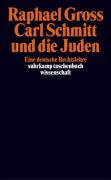
Carl Schmitt und die Juden
De rooie rat is failliet, u kunt niet meer bestellen. ISBN: 9783518293546 Taal: Duits Jaar: 2009 Uitgever: Suhrkamp filosofie politieke theorie antisemitisme duitslandCarl Schmitt, einer der einflußreichsten deutschen Staatstheoretiker des 20. Jahrhunderts, war von der "Judenfrage" geradezu besessen. Seiner Aura hat dies keineswegs geschadet. Im Gegenteil, der Kontrast zwischen der Abgründigkeit seiner Judenfeindschaft und seinem als brillant gerühmten Denken hat die Faszination seines Werks nur erhöht.
Gross untersucht den historischen Kontext, in dem Schmitts ständige Auseinandersetzung mit Juden und "dem Jüdischen" stand, und wiesich dies in seinen wichtigsten Begriffspaaren niederschlug: Freund und Feind, Nomos und Gesetz, Katechon und Antichrist. Dabei wird deutlich, wie sich seine politische Theologie im Nationalsozialismus wandelte, als Schmitt eine Biologisierung des Politischen unternahm und eine "artgerechte", "deutsche" Rechtslehre entwarf. Sein Denken läßt, wie Gross zeigt, die Übergänge von einer religiös begründeten Judenfeindschaft zum modernen Antisemitismus sichtbar werden.
Review
" No one interested in Carl Schmitt can afford to ignore Raphael Gross' s powerful discussion of how intimately linked were Schmitt' s anti-Semitism and his political theory. Gross persuasively argues that Schmitt' s post 1933 writings on the " Jewish" origins of universalism and positivism had a central importance for both Nazi aims and his work as a whole. A new Afterword demonstrates that Gross' s work has elicited a broad discussion and inserts his own moral and intellectual voice into contemporary debates." -- Anson Rabinbach, Princeton University
Product Description
German jurist and legal theorist Carl Schmitt (1888-1985) significantly influenced Western political and legal thinking in the last century, yet his life and work have also stirred considerable controversy. While his ideas have been used and diffused by prominent philosophers on both the left and the right, such as Jurgen Habermas and Leo Strauss, his Nazi-era past, especially his active efforts to remove Jewish influence from German law, has cast a cloud over his life and oeuvre. Still, his many supporters have generally been successful in claiming that Schmitt's was an "antisemitism of opportunity," a temporary affectation to gain favor with the Nazis. In "Carl Schmitt and the Jews", available in English for the first time, historian Raphael Gross vigorously repudiates this "opportunism thesis." Through a reading of Schmitt's corpus, some of which became available only after his death, Gross highlights the importance of the "Jewish Question" on the breadth of Schmitt's work. According to Gross, Schmitt's antisemitism was at the core of his work - before, during, and after the Nazi era. His influential polarities of "friend and foe," "law and nomos," "behemoth and Leviathan," and "ketechon and Antichrist" emerge from a conceptual template in which "the Jew" is defined as adversary, undermining the Christian order with secularization. The presence of this template at the heart of Schmitt's work, Gross contends, calls for a major reassessment of Schmitt's role within contemporary cultural and legal theory.
Gerelateerde boeken
 Oorlog en biografie in Banja Luka, Bosnië-Herzegovina. €14,50 |
 €15,75 |
 Water War In Bolivia. €13,00 |
 €19,95 |