
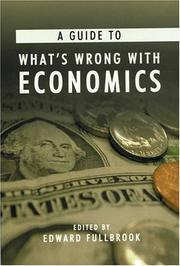
Guide to What's Wrong with Economics.
De rooie rat is failliet, u kunt niet meer bestellen. ISBN: 9781843311485 Taal: Engels Jaar: 2009 politieke theorie politieke economie globaliseringFrom the 1960s onward, neoclassical economists have increasingly managed to block the employment of non-neoclassical economists, narrow the economics curriculum offered by universities to students and make their theories increasingly irrelevant to understanding economic reality. Now, they are even banishing economic history and the history of economic thought from the curriculum. Why has this tragedy happened?
At this time of accelerating momentum for radical change in the study of economics, A Guide to What?s Wrong with Economics comprehensively examines the shortcomings of neoclassical economics and considers a number of alternative formulations. In it, a distinguished list of non-neoclassical economists provide an examination of some of the many worldly and logical gaps in neoclassical economics, its hidden ideological agendas, disregard for the environment, habitual misuse of mathematics and statistics, inability to address the major issues of economic globalization, its ethical cynicism concerning poverty, racism and sexism, and its misrepresentation of economic history.
In clear and engaging prose, A Guide to What?s Wrong with Economics shows how interesting, relevant and exciting economics can be when it is pursued, not as a defense of an antiquated and close-minded system of belief but as a no-holds barred inquiry looking for real-world truths.
About Authors, Editors, and Contributors
Edward Fullbrook is a Visiting Research Fellow at the School of Economics, University of the West of England. He is the founder and editor of the Post-Autistic Economics Review. Among other books, he has edited The Crisis in Economics (Routledge, 2003) and Intersubjectivity in Economics (Routledge, 2002).
Table of Contents
Introduction: Broadband Versus Narrowband Economics
Edward Fullbrook, University of the West of England, UK
I. BASIC PROBLEMS
1. The Quarrelsome Boundaries of Economics
Hugh Stretton, University of Adelaide, Australia
2. Modern Economics: the Problem and a Solution
Tony Lawson, Cambridge University, UK
3. The Pitfalls of Mainstream Economic Reasoning (and Teaching)
Michael A. Bernstein, University of California, San Diego, USA
4. Neoclassical Economic Theory: A Special and not a General Case
Paul Ormerod Volterra Consulting, UK
5. Where do Economies Come From? The Missing Story
Anne Mayhew, University of Tennessee, USA
6. Can Economics Start From the Individual Alone?
Geoffrey M. Hodgson, University of Hertfordshire, UK
II. MICRO NONSENSE
7. Are You Rational?
Edward Fullbrook, University of the West of England, UK
8. Five Pieces of Advice for Students Studying Microeconomics
Emmanuelle Benicourt, École des Hautes Études des Sciences Sociales, France
9. How Mainstream Economists Model Choice, Versus How We Behave, and Why it Matters
Peter E. Earl, University of Queensland, Australia
10. Managerial Economics: Economics of Management or Economics for Managers?
Sashi Sivramkrishna, Foundation to Aid Industrial Recovery, India
III. MACRO NONSENSE
11. Why do we Have Separate Courses in ?Micro? and ?Macro? Economics?
Ozgur Gun, Université de Reims Champagne Ardenne, France
12. The ?Natural? Rate of Unemployment
James G. Devine, Loyola Marymount University, USA
13. How to Look at Economics Critically: Some Suggestions
Renato Di Ruzza, Université de Aix-Marseille, France
Joseph Halevi, University of Sydney, Australia and Université Pierre
Mendès France, France
IV. ETHICAL VOIDS AND SOCIAL PATHOLOGIES
14. Teaching Economics as if Ethics Mattered
Charles K. Wilber, University of Notre Dame, USA
15. Economics as Ideology and the Need for Pluralism
Peter Söderbaum, Mälardalen University, Sweden
16. The ?Efficiency? Illusion
Richard Wolff, University of Massachusetts, Amherst, USA
17. ?There are None so Blind . . . ,
Susan F. Feiner, University of Southern Maine
V. MISUSE OF MATHEMATICS AND STATISTICS
18. Can Mathematics be Used Successfully in Economics?
Donald Gillies, King?s College London, UK
19. Can we Expect Anything From Game Theory?
Bernard Guerrien, Université Paris I, France
20. Improbable, Incorrect or Impossible: The Persuasive but Flawed Mathematics of Microeconomics
Steve Keen, University of Western Sydney, Australia
21. The Significance of the Economics Research Paper
Stephen T. Ziliak, Roosevelt University, USA
VI. CATEGORY MISTAKES REGARDING WEALTH AND ILLTH
22. Changing Visions of Humans? Place in the World and the Need for an Ecological Economics
Robert Costanza, The University of Vermont, USA
23. Ecological Economics: The Concept of Scale and its Relation to Allocation, Distribution, and Uneconomic Growth
Herman E. Daly, University of Maryland, USA
24. What?s Wrong with GDP and Growth? The Need for Alternative Indicators
Jean Gadrey, Université Lille, France
VII. GLOBALIST DISTORTIONS
25. What is Wrong with the ?Official History of Capitalism?? With Special Reference to the Debates on Globalization and Economic Development
Ha-Joon Chang, Cambridge University, UK
26. Should the Study of Transnational Companies be Part of the Economics Syllabus?
Grazia Ietto-Gillies, London South Bank University, UK
27. Would a Latin American Economics Make Sense?
Ana Maria Bianchi, University of Sao Paulo, Brazil
Notes 310
Name Index 321
Gerelateerde boeken
 €23,00 |
 Creating New Wealth, Work and a Wiser World. €19,95 |
 Veertig jaar Humanistische Verzorging bij de inrichtingen van Justitie. €12,50 |
 €17,90 |