
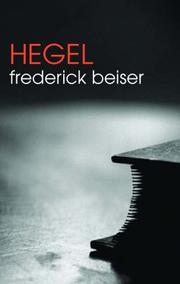
Hegel (1770-1831)
De rooie rat is failliet, u kunt niet meer bestellen. ISBN: 9780415312080 Taal: Engels Jaar: 2005 Uitgever: Routledge filosofieHegel (1770-1831) is one of the towering philosophers of the nineteenth century. Many of the major philosophical movements of the twentieth century--from existentialism to analytic philosophy -- also grew out of reactions against Hegel. He is also one of the hardest philosophers to understand and his complex ideas, though rewarding, are often misunderstood.
In this magisterial and lucid introduction, Frederick Beiser covers every major aspect of Hegel's thought. He places Hegel in the historical context in nineteenth century Germany while clarifying the deep insights and originality of Hegel's philosophy.
Table of Contents
Introduction, p. 1.
1. A Question of Relevance
2. A Question of Method
3. Brief Biography
PART I: EARLY IDEALS AND CONTEXT
Chapter 1: Cultural Context, p. 23
1. The Twilight of the Enlightenment
2. Antifoundationalism
3. The Pantheism Controversy
4. The Birth of Nihilism
5. The Rise of Historicism
6. The Theory-Practice Debate
Chapter 2: Early Ideals, p. 39
1. The Romantic Legacy
2. The Highest Good
3. Ethical Ideals
4. Political Ideal
5. Religious Ideal
6. The Challenge of Division
PART II: METAPHYSICS
Chapter 3: Absolute Idealism, p. 59
1. The Question of Metaphysics
2. What is the Absolute?
3. Subject-Object Identity
4. The Meaning of 'Idealism'
5. The Synthesis of Idealism and Realism, Freedom and Necessity
6. The Myth of Panlogicism?
Chapter 4: The Organic Worldview, p. 94
1. The Organic Dimension
2. The Rise of Organicism
3. Hegelian Origins
4. The Spinoza Legacy
5. The Kantian Legacy and Challenge
6. Reply to Kant
7. In Defense of Naturphilosophie
8. Myths about Naturphilosophie
Chapter 5: The Realm of Spirit, p. 131
1. Life and Spirit
2. The Spirit of Love
3. The Metaphysics of Love
4. The Transformation of Love
Chapter 6: The Religious Dimension, p. 150
1. The Unending Debate
2. Early Critique of Christianity
3. Reversal in Frankfurt
4. A New Religion
5. Mature Standpoint
6. Concept of God
7. The Identity Thesis
PART III: EPISTEMOLOGICAL FOUNDATIONS
Chapter 7: The Dialectic, p. 190
1. A Critical Foundation for Metaphysics
2. Myths and Legends about Dialectic
3. Structure of the Dialectic in the Logic
4. Task of Dialectic in the Phenomenology
Chapter 8: Solipsism and Intersubjectivity, p. 211
1. The Spectre of Nihilism
2. The Context of the Argument
3. The Dialectic of Desire
4. Lordship and Bondage
PART IV: SOCIAL AND POLITICAL PHILOSOPHY
Chapter 9: Freedom and the Foundation of Right, p. 235
1. Metaphysics and Politics
2. The Concept of Freedom
3. A Betrayor of Liberty?
4. The Foundation of Law
5. Machiavelli's Challenge
6. The Idealism of a Reformer
Chapter 10: Hegel's Theory of the State, p. 271
1. Hegel's Political Project
2. The Critique of Liberalism and Communitarianism
3. Ethical Life
4. The Organic State
5. Civil Society
6. The Structure and Powers of the State
PART V: PHILOSOPHY OF CULTURE
Chapter 11: Philosophy of History, p. 314
1. Hegel and Historicism
2. Reason in History
3. Cunning of Reason
4. The Problem of Evil
5. The Meaning of Life
6. Hegel versus the Existentialists
Chapter 12: Aesthetics, p. 339
1. The Paradox of Hegel's Aesthetics
2. The Subordination Thesis
3. Art as Cognition
4. Death of Art
Epilogue, p. 370
Further Reading, p. 379
Gerelateerde boeken
 €5,90 |
 €22,19 |
 €34,95 |
 Ajax, Meisjes uit Trachis, Elektra en Filoktetes. €29,50 |