
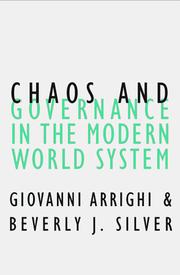
Chaos and Governance in the Modern World System Series Contradictions of Modernity, Volume 10
De rooie rat is failliet, u kunt niet meer bestellen. ISBN: 9780816631520 Taal: Engels Jaar: 1999 Uitgever: Univ. of Minnesota Press politieke theorie politieke economie globalisering noord-zuid relatieExamines what historic transformations in power relationships can teach us about our own time-and about what lies ahead.
In a period of dramatic transformation and upheaval, as we wonder what the future holds, this book reminds us that the world has undergone enormous changes before and that an understanding of those changes may tell us something about our own turbulent time.
The authors look to two earlier periods that resemble the present in key respects-the transition from Dutch to British world hegemony in the eighteenth century and the transition from British to U.S. world hegemony in the late-nineteenth and early-twentieth centuries. In each case, a systemwide expansion culminated in crisis and systemic chaos; eventually, a new hegemonic power reorganized the system to solve the problems and contradictions that underlay the chaos.
The authors find recurrent characteristics in these transitions, such as the resurgence of finance capital and the intensification of interstate rivalries and social conflict. They also recognize, however, how the present transition differs from the previous patterns. Among the anomalies are the proliferation of transnational organizations and communities, increased social conflict in driving systemic change, a geographical split between military and financial powers, and a shift in the processes of capital accumulation away from the West.
Chaos and Governance in the Modern World System addresses controversies affecting a range of fields-political, economic, social, and cultural-concerned with global change. Though written from a world-systems perspective, it emphasizes the instability and adaptability of world capitalism and the role played by hegemonic states in periodically reorganizing the system.
"Arrighi and Silver present us with a bold and theoretically sophisticated restatement of the declinist thesis, which sets the contemporary U.S.-centered world system in perspective with previous examples of hegemonic decline, namely, the Dutch and the British. In doing so they provide a provocative and persuasive analysis of both the current world system and its likely future trajectory. The authors have succeeded in pushing forward the frontiers of thinking theoretically about hegemony and stability in the international system. They have reminded us that despite this current climate of financial market euphoria, as the seasons cycle, autumn must arrive." -Political Science Quarterly
"Giovanni Arrighi and Beverly Silver command admiration for the clarity and precision of their argument, and for their mastery of the literature about 'world systems' that flourishes among residual Marxists, who yearn for a foreseeable catastrophe for capitalism in an age when older recipes for its demise are less plausible. I also admire the open-endedness of their analysis of the contemporary situation, their reach into the past for analogues to current perplexities, and their recognition of how the 'post 1970s crisis' they think we are experiencing differs from the two previous hegemonial transfers they compare with it." -Political Power and Social Theory
"The arguments are illuminating. A key value of this book lies in the way comparisons illuminate macroprocesses and global dynamics that lie hidden from other perspectives. Arrighi and Silver's book offers challenging and illuminating arguments and significant alternatives for understanding our current global condition." -International Affairs
"The book will give you not only new ideas, but much new information about the modern world as well." -The Futurist
"In the context of debates over the future tendencies of the world economy in an era of rapid globalization, this book is a timely reminder that the current conjecture has been shaped by structures and processes that have been in play for at least the last four hundred years. The book offers a compelling alternate world-historical interpretation of political, social and economic structures and processes in the making of the modern world. It is a valuable and timely addition to the ongoing debate on the future of the world economy in an era of political and economic uncertainties." -Canadian Journal of Sociology
"Arrighi, Silver, and their collaborators have produced a book that cuts through the fog enveloping current discussions of globalization. Together with their reconstruction of past transitions, their account of the present shows clearly which features are cyclical recurrences, which are new variations on old themes, and which are truly novel transformations. The result is a masterful blend of theoretical reasoning, empirical analysis, and informed projection." -Walter L. Goldfrank, University of California at Santa Cruz
Giovanni Arrighi is professor of sociology at Johns Hopkins University. Among his books is The Long Twentieth Century: Money, Power, and the Origins of Our Times (1994). Beverly J. Silver is associate professor of sociology at Johns Hopkins University.
Winner of the American Sociological Association's Section on the Political Economy of the World-System Book Award
Gerelateerde boeken
 Concepts and Measurements of Migration in Europe. €39,50 |
 Stof voor een socialisme zonder blauwe plekken. €5,00 |
 Wie regisseert de veranderingen in het Nederlandse landschap? Met beeldessay van Theo Baart. €12,50 |
 Stad van geesten 1430-1950. €15,00 |